Mass spectacle
Staging a crowd as an image: thousands arranged in blocks, moving as one, lit and filmed so that the viewer sees unanimity and feels the choice already made.
A crowd is an argument about numbers, and a choreographed crowd is an argument about agreement. Nobody in a block of ten thousand is disagreeing, because the block has been drilled not to, and the viewer at home, who was not there, sees a nation that has decided. The spectacle works on the participants too: a man who has marched in step for an afternoon has felt what the regime wants him to believe, and feeling is easier to remember than argument.
The form was perfected by regimes that could compel attendance and film it, and it persists in every stadium rally and convention floor, where the cameras are placed where the crowd fills them. Exploits Bandwagon Effect and Conformity.
Historical examples
Leni Riefenstahl's Triumph of the Will recorded the party rally of September 1934 with thirty cameras, cranes, and tracks laid for the purpose; Albert Speer designed the grounds and the "cathedral of light" of searchlights for the film as much as for those present. The crowd was a set, and the film is the rally most people have seen.
Kershaw, Ian. The "Hitler Myth": Image and Reality in the Third Reich. Oxford: Oxford University Press, 1987; Speer, Albert. Inside the Third Reich. New York: Macmillan, 1970.
The Arirang mass games put as many as a hundred thousand performers in the May Day Stadium, with a backdrop of some twenty thousand schoolchildren turning colored cards in unison to make pictures of the leaders and the harvest. Participants rehearsed for months; attendance at the stands was arranged.
Kim, Suk-Young. Illusive Utopia: Theater, Film, and Everyday Performance in North Korea. Ann Arbor: University of Michigan Press, 2010.
The Olympic opening ceremony and Riefenstahl's Olympia presented the regime through stadium choreography, torch relay, and massed salutes, in a form borrowed from the Nuremberg rallies and lent to sport. Foreign visitors reported the order and the unanimity; the camps were an hour away.
Hilton, Christopher. Hitler's Olympics: The 1936 Berlin Olympic Games. Stroud: Sutton, 2006; Large, David Clay. Nazi Games: The Olympics of 1936. New York: W. W. Norton, 2007.
In the archive
Posters and advertisements annotated with this technique.
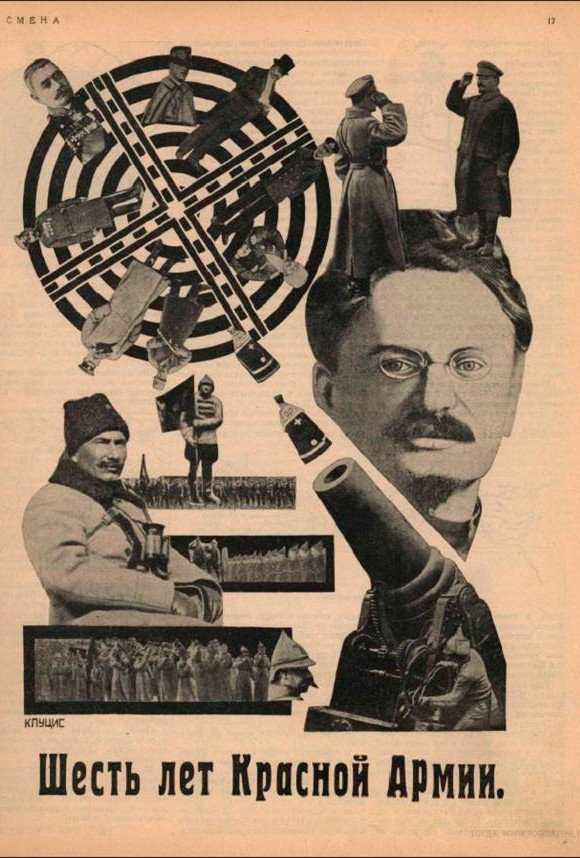
Watch footage of a mass rally. Who chose where the camera stood, and what would the same crowd look like filmed from behind, or from above at the end of the day?
In the wild
Short examples of the technique at work, each with what to notice. The same examples are questions in the quiz, where the answer is not given away.
A government broadcasts a stadium of fifty thousand turning colored cards to form the leader's face, filmed from the one seat where the face is undistorted.
What to notice. The crowd is a picture. The agreement it shows was rehearsed, and the camera was placed for it.
A party convention fills the floor with identical signs on cue and cuts to a wide shot from the ceiling as the chant begins.
What to notice. The unanimity is staged for the camera; the viewer at home sees a decision made.
A city's victory parade is reported by its organizers as spontaneous; the schools were closed and attendance was taken.
What to notice. Organized attendance presented as a crowd's feeling. The spectacle is the claim.
Sources
- Kershaw, Ian. The "Hitler Myth": Image and Reality in the Third Reich. Oxford: Oxford University Press, 1987. ISBN 978-0192802064
- Kim, Suk-Young. Illusive Utopia: Theater, Film, and Everyday Performance in North Korea. Ann Arbor: University of Michigan Press, 2010. ISBN 978-0472117086
- Mosse, George L. The Nationalization of the Masses. New York: Howard Fertig, 1975. ISBN 978-0865274174