Heroic scale
Drawing the leader, the nation, or the cause far larger than the people and places around it, so that size does the work of argument: what is this big must be this important.
Scale is the oldest visual claim there is. Pharaohs were carved larger than their armies; the device has not changed, only the printing. A figure that fills the sheet while the crowd is a frieze at its feet is not described as great; it is seen as great, and the viewer's own body, which is smaller still, agrees. The giant also has no context: nothing beside it is large enough to compare with, so it cannot be measured.
The device appears in statues, posters, and now in camera framing, and it attaches to products as easily as to leaders. Exploits Halo Effect and Anchoring.
Historical examples
From the civil war on, Soviet posters drew Lenin, and then Stalin, at a scale the crowds and buildings did not share: Lenin striding across the globe with a broom, Stalin's head above a parade of thousands. Victoria Bonnell's study of the posters traces the leader's growth from a man among workers in 1920 to a colossus above them by 1935.
Bonnell, Victoria E. Iconography of Power: Soviet Political Posters under Lenin and Stalin. Berkeley: University of California Press, 1997, ch. 4.
The bronze of Kim Il-sung on Mansu Hill, unveiled for his sixtieth birthday, stands about twenty meters high over the city, with a mosaic of Mount Paektu behind it; visitors are expected to bow at its feet. A matching statue of Kim Jong-il was added in 2012. The scale is the state's argument about the man.
Portal, Jane. Art Under Control in North Korea. London: Reaktion Books, 2005.
In advertising and commerce
N. C. Wyeth's war-bond poster shows Uncle Sam striding through storm clouds, the size of a mountain, with a column of infantry charging at his feet. Wyeth was the country's best-known book illustrator, and the sheet reads as an adventure-story cover: the nation as a giant and the viewer's savings as the price of joining the column below it.
Library of Congress, Prints and Photographs Division, LC-USZC4-9554; Meyer, Susan E. America's Great Illustrators. New York: Abrams, 1978.
In the archive
Posters and advertisements annotated with this technique.
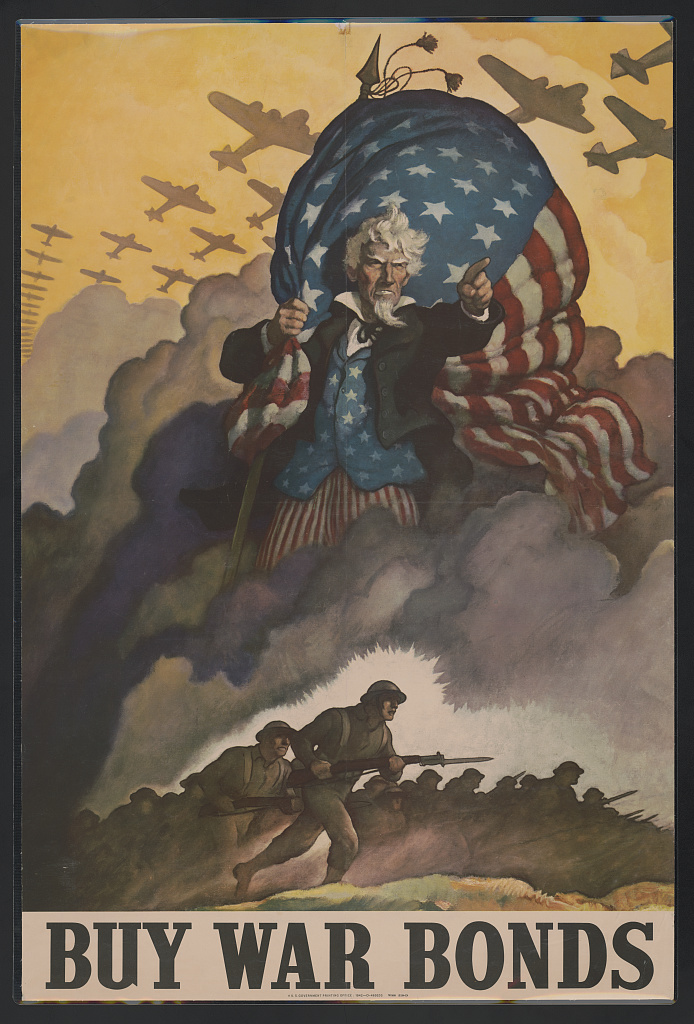
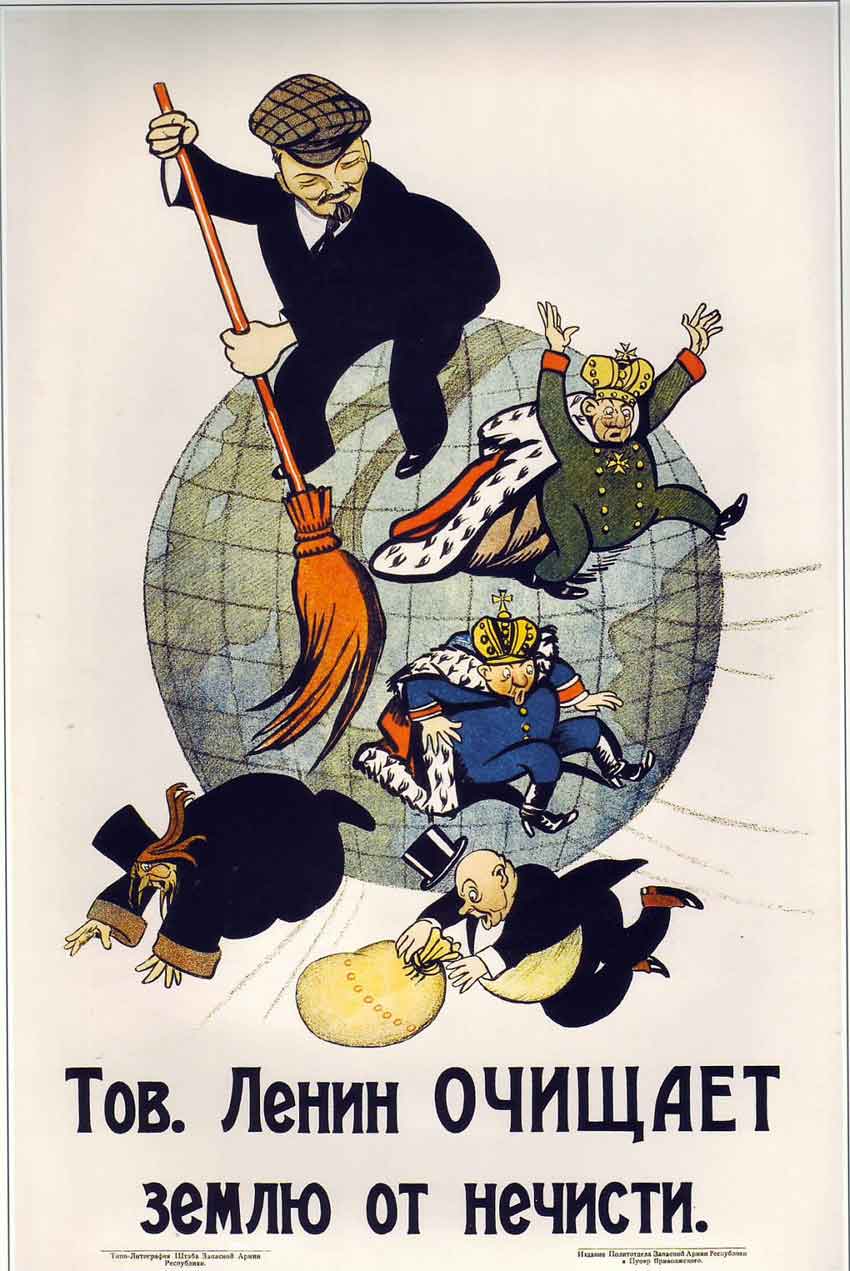
Find a poster or statue in which one figure is far larger than the others. What does the size say, and would the viewer accept it if it were written as a sentence?
In the wild
Short examples of the technique at work, each with what to notice. The same examples are questions in the quiz, where the answer is not given away.
A campaign poster shows the candidate's head and shoulders filling the sheet, with the city skyline drawn small along the bottom edge.
What to notice. The candidate is the size of the city. Nothing is said; the ratio is the claim.
An advertisement shows a new phone held in a hand drawn so small that the phone is the size of a door.
What to notice. The product is enlarged against its own user; importance is drawn as size.
A party's rally stage carries a portrait of the leader five stories high, under which the speakers stand.
What to notice. The leader is bigger than the building. The portrait's size is the argument about the man.
Sources
- Bonnell, Victoria E. Iconography of Power: Soviet Political Posters under Lenin and Stalin. Berkeley: University of California Press, 1997. ISBN 978-0520221536
- Portal, Jane. Art Under Control in North Korea. London: Reaktion Books, 2005. ISBN 978-1861892362
- Paret, Peter, Beth Irwin Lewis, and Paul Paret. Persuasive Images: Posters of War and Revolution from the Hoover Institution Archives. Princeton: Princeton University Press, 1992. ISBN 978-0691032047