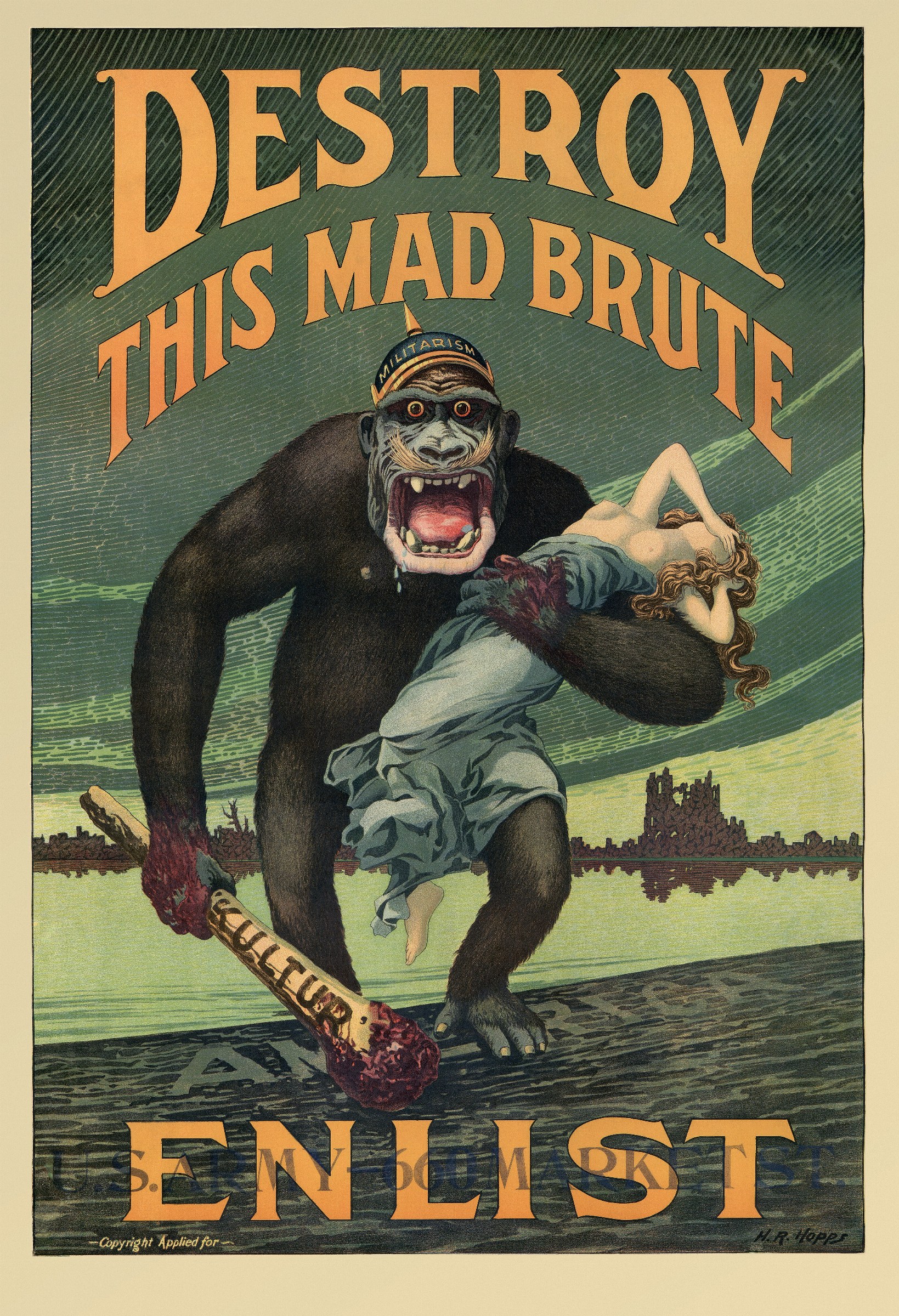
Destroy this mad brute
 1
2
3
4
Library of Congress · LC-DIG-ds-03216 · Public domain · Catalog record
The pins
Context
For discussion
-
1
Dehumanizing imagery The gorilla's face Germany is not a country or an army but an animal: bared teeth, blood on the lips, no reason to appeal to. An enemy that is not human cannot be negotiated with, only destroyed.
-
2
Labeling The helmet, "Militarism" The spiked Pickelhaube is labeled "militarism" and the club "Kultur," the German word for civilization. The labels tell the viewer that German culture itself is the weapon.
-
3
Appeal to outrage The woman The half-naked, fainting woman stands for Belgium and for every atrocity story of 1914. She is there to make the viewer angry before he reads a word.
-
4
Appeal to fear The shore, "America" The ape has stepped onto American soil, with Europe burning behind it. A war three thousand miles away is made a threat to the viewer's own street.
Painted by Harry Ryle Hopps for Army recruiting in 1917, the year the United States entered the war. Germany is a gorilla wearing a spiked Pickelhaube marked "militarism," carrying a bloodied club labeled "Kultur" and a half-naked woman, and stepping onto the American shore from a ruined Europe. The image borrowed the atrocity stories of the Belgian invasion and turned them into a threat at home; the Nazis later reprinted it as evidence of Allied hatred.
- The ape has already landed in America. What does placing the threat on home soil do that a picture of Belgium would not?
- The club is labeled "Kultur" and the helmet "militarism." Why label an image that is already this explicit?
- The same poster was reprinted by German propagandists in the 1930s. What made it useful to them?
See also
Same era, or the same techniques.