Help!
 1
2
3
Other · File:D. Moor Pomogi.jpg · Public domain · Catalog record
The pins
Context
For discussion
-
1
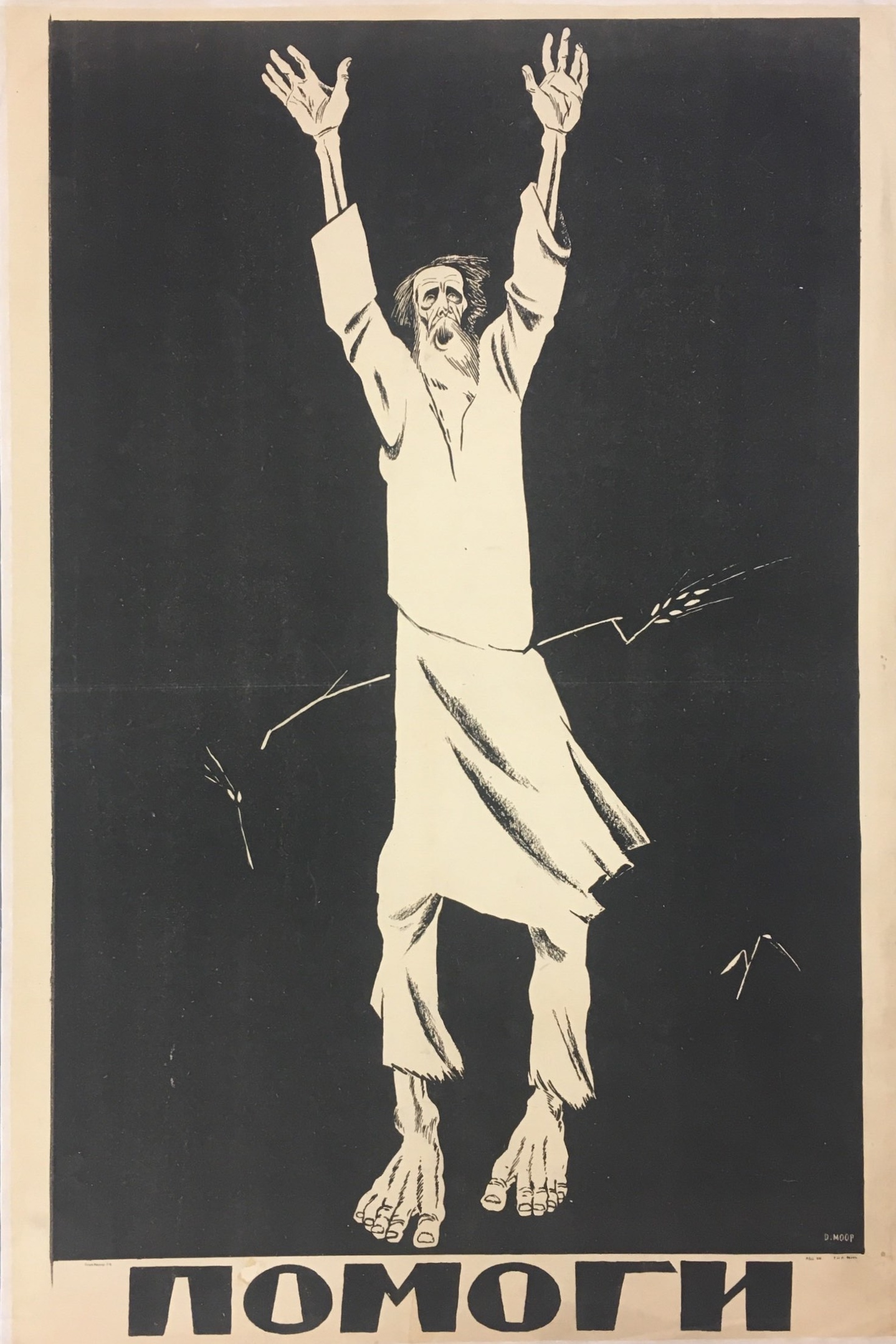
Appeal to pity The face An old man, hollow-eyed, arms raised, mouth open. There is no argument and no enemy; the viewer is asked only to feel.
-
2
Oversimplification The ear of wheat One broken stalk stands for the harvest of the whole Volga. The famine's causes, drought, requisitioning, and war, are outside the frame.
-
3
Slogan "Pomogi" One word, the imperative singular. Like "Enlist" of 1915, the figure supplies the reason and the word supplies the order.
Dmitry Moor's "Pomogi!" of 1921, for the famine on the Volga that killed about five million people. A starving old man stands in white against black, arms raised, a single broken ear of wheat beside him and one word beneath. Moor said he drew it in a night. It is a propaganda poster in the sense that it was state-issued to move people to act, and it shows how little of the usual apparatus the form needs when the cause is real.
- Is this propaganda? What would make it so, or not?
- Compare it with "Enlist" from 1915. Both use one word and one figure. What is different?
- The ear of wheat is broken. Why include it at all?
See also
Same era, or the same techniques.