The union of worker and peasant
 1
2
3
Library of Congress · Public domain · Catalog record
The pins
Context
For discussion
-
1
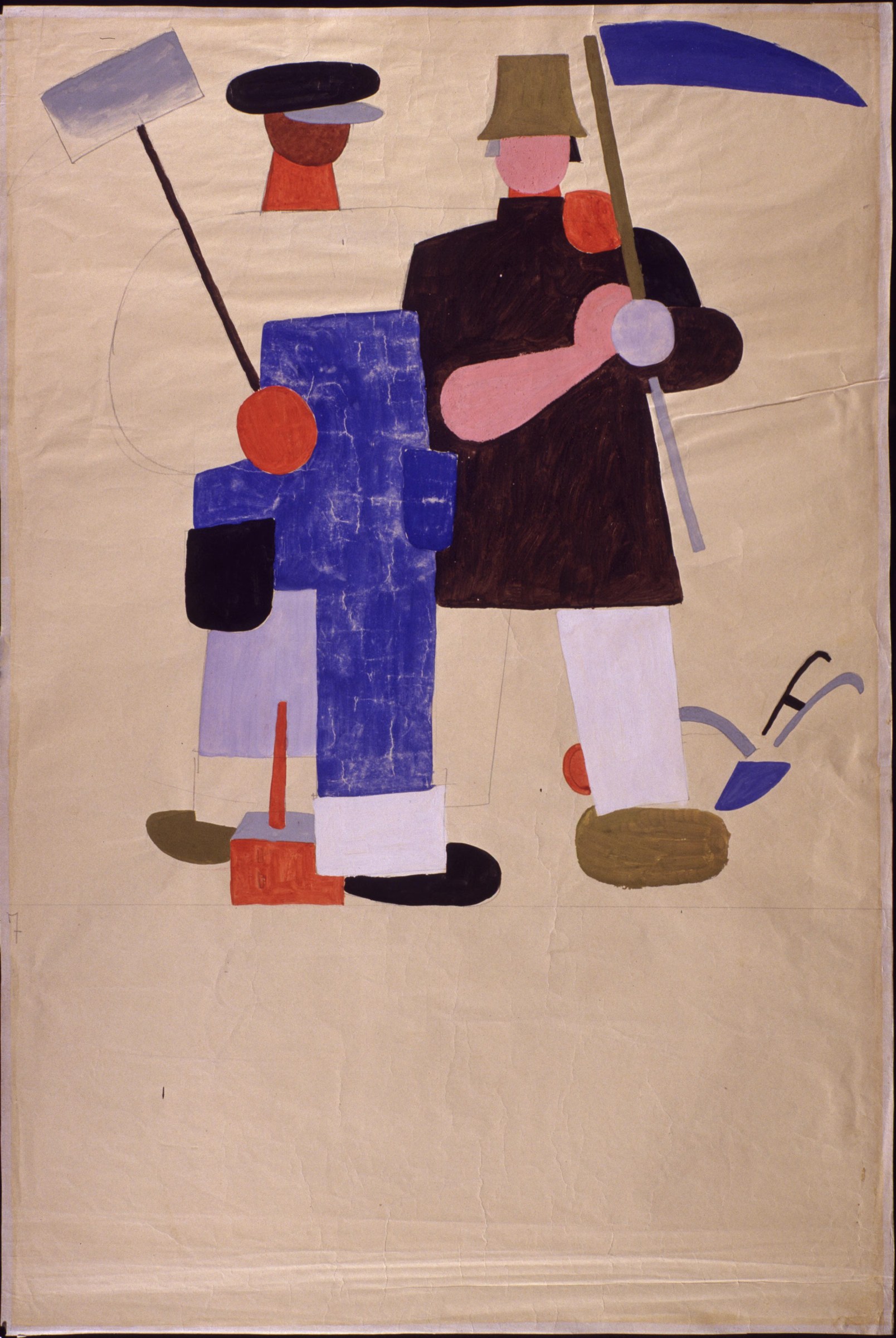
Glittering generalities The pair "Union" is the title, but the two figures neither touch nor look at each other. The word claims an alliance the picture does not quite show, which was also true of the policy.
-
2
Plain folks The worker Blue overalls, cap, sledgehammer: the ruling class of the new state drawn as a man you might pass in the street.
-
3
Symbol appropriation The scythe Hammer and scythe, a year before the hammer and sickle was fixed on the state seal. The tools of two trades become the emblem of one party.
A Petrograd ROSTA window of 1921 by Vladimir Lebedev. A worker in blue with a sledgehammer and a peasant in brown with a scythe stand side by side, built from flat colored shapes. The alliance, "smychka," was the official doctrine of a party that ruled a country of peasants in the name of a small working class, and the handshake was its standard image, repeated on coins, banners, and the state seal.
- The two figures are the same height and drawn in the same style. What was true about their standing in 1921?
- The two figures do not touch or look at each other. Where is the "union" in the picture?
- The hammer and sickle appeared on the state seal in the same years. What does repetition across objects do?
See also
Same era, or the same techniques.