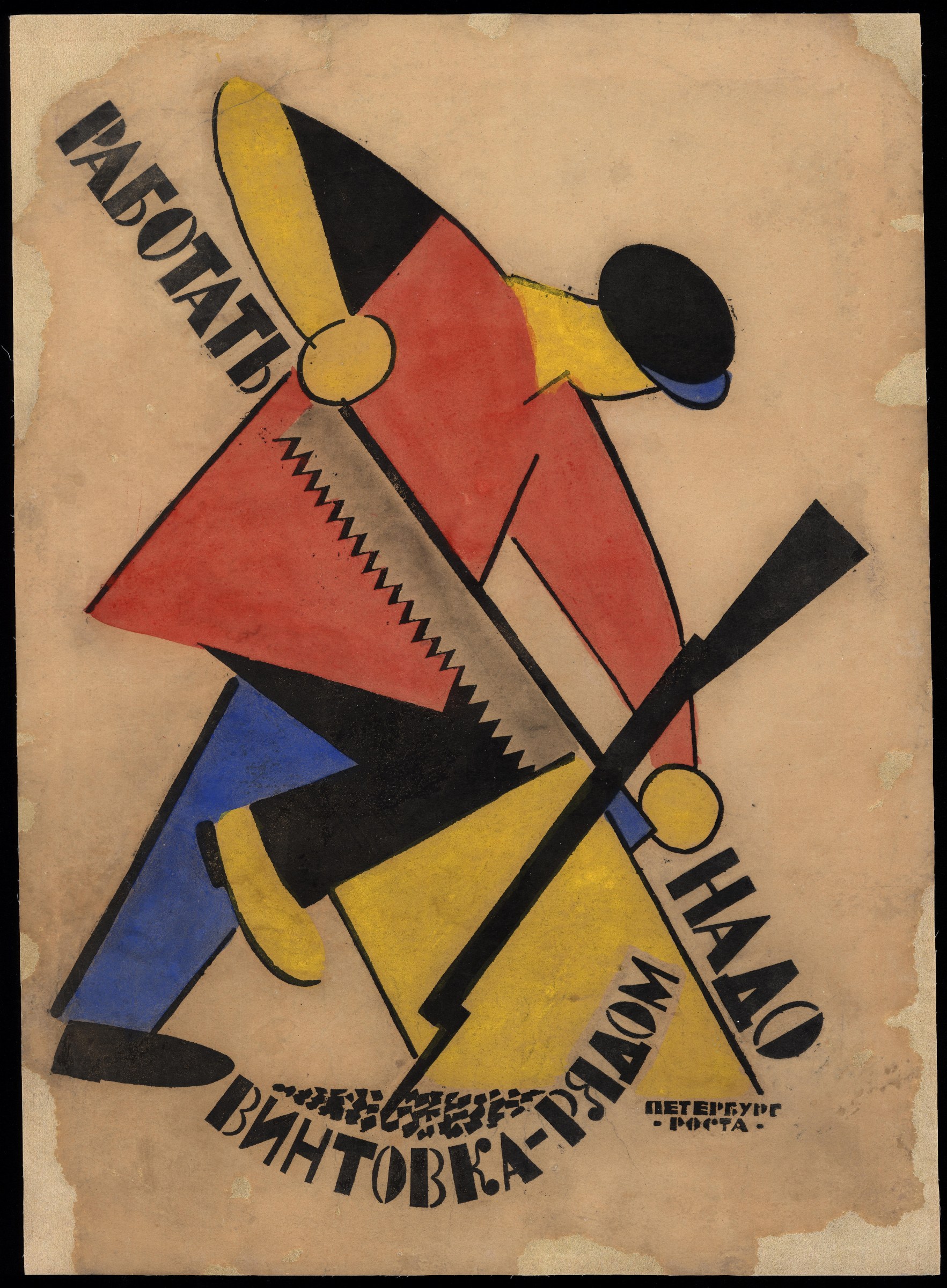
One must work, the rifle is right here
 1
2
3
Library of Congress · Public domain · Catalog record
The pins
Context
For discussion
-
1
Slogan "Rabotat nado" "One must work": three words, set at an angle so that they are part of the swing of the hammer. The sentence and the gesture are one thing.
-
2
Idealized figure The worker No face, no name: a figure built from red, yellow, and black shapes. He is not a worker but Work, which cannot be argued with.
-
3
Oversimplification The rifle The rifle leans within reach. Labor and defense are shown as one act, with no gap in which a worker might prefer one to the other.
A Petrograd ROSTA window of 1920 by Vladimir Lebedev. A worker in a red shirt swings a hammer at an anvil with a rifle leaning beside him. Lebedev's Petrograd windows were flatter and more geometric than the Moscow ones, and this is the civil-war slogan of labor and defense as a single act: the worker who is also a soldier, with no gap between the two.
- The rifle is within reach but not in use. What is being said about work?
- The figure has no face. Who is he meant to be?
- Why might a poster with almost no words have been useful in 1920 Russia?
See also
Same era, or the same techniques.