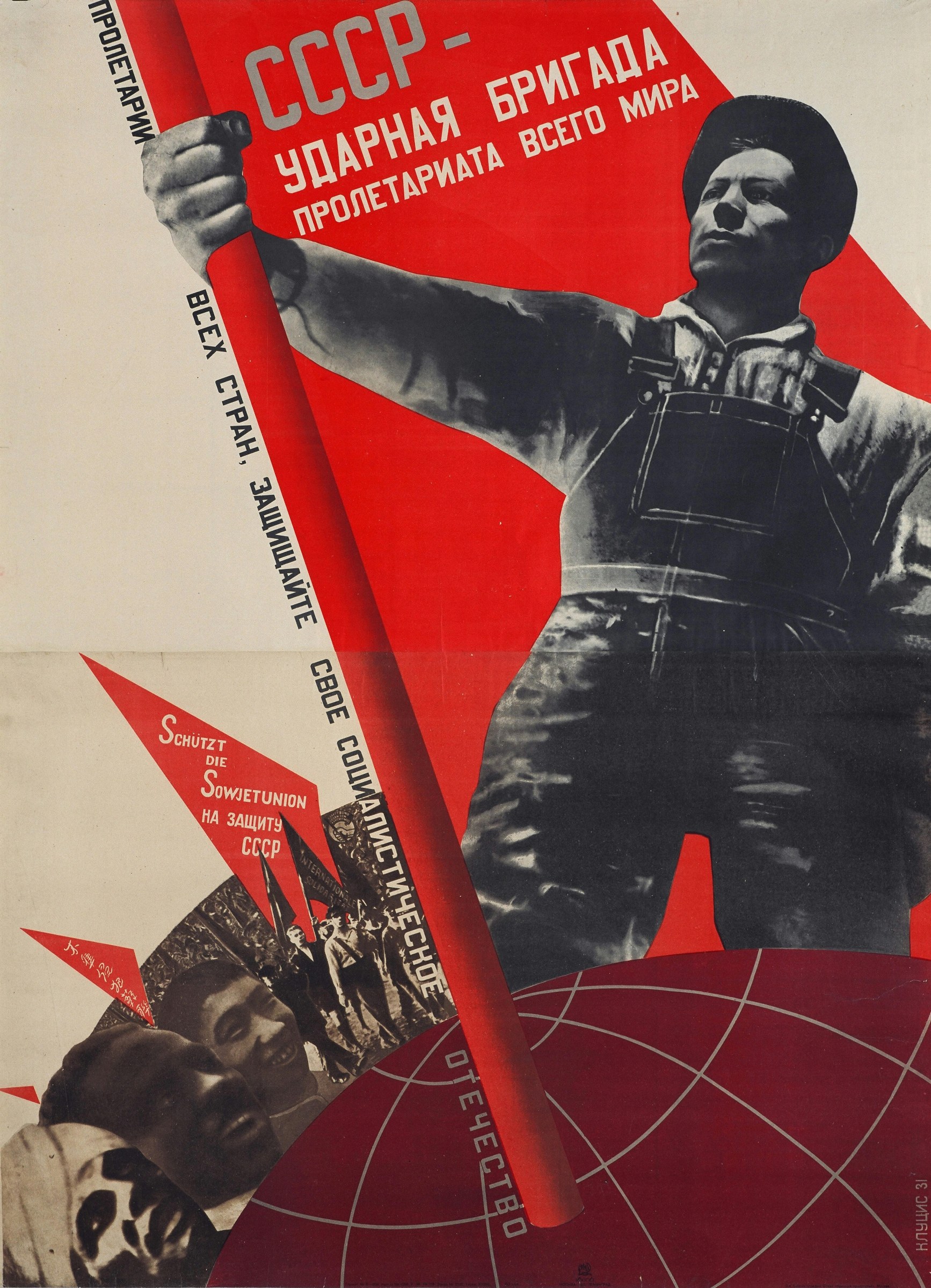
The USSR is the shock brigade of the world proletariat
 1
2
3
4
Other · File:USSR – shock brigade of the world proletariat - Gustavs Klucis.jpg · Public domain · Catalog record
The pins
Context
For discussion
-
1
Camera angle The worker A photographed worker, enlarged to the height of the sheet, holding the flagstaff. The Soviet working class as one man, seen from below.
-
2
Slogan The headline "The USSR is the shock brigade of the world proletariat." A factory term for the hardest-working team, applied to a country, in the year of the first Five-Year Plan's failures.
-
3
Hyperbole The globe The worker stands on the world, the flagstaff planted in it. One country as the vanguard of everyone.
-
4
Bandwagon The appeals in other languages "Proletarians of all countries, defend your socialist fatherland," in Russian, German, and Chinese, with photographed crowds. The world is already marching; the viewer is asked to notice.
Gustav Klutsis's photomontage of 1931. Workers at a construction site, a crowd below, a red banner, and the slogan diagonally across the sheet. Klutsis built his posters from photographs cut and rephotographed, and the technique lent the claim the authority of a document: these are real workers, these are real cranes. He was shot in 1938 in the purge of Latvians.
- Photographs feel like evidence. What does montage do to that feeling?
- "Shock brigade" was a factory term for the hardest-working team. What is it claiming when applied to a country?
- Where is the viewer standing in this picture?
See also
Same era, or the same techniques.