Thought-terminating cliché
A short, familiar phrase deployed to end a line of thought or discussion, so that a question that deserves an answer is dismissed instead with a formula.
Some phrases are shaped like conclusions. "It is what it is." "Everything happens for a reason." "You can't argue with success." "That's just how things are done." Each arrives with the cadence of a settled matter, and the person who hears one feels the conversation close even though nothing has been resolved. The device uses that shape on purpose: when a question is inconvenient, a cliché is dropped on it.
Robert Jay Lifton identified the pattern in his 1961 study of thought reform, where he found that "the most far-reaching and complex of human problems are compressed into brief, highly reductive, definitive-sounding phrases, easily memorized and easily expressed." The phrases did not answer doubts; they made doubting feel like a failure of belonging. Exploits Cognitive Ease and Conformity.
Historical examples
Lifton's interviews with people who had been through "thought reform" in China in the 1950s led him to name the device. Political doubts were met with formulas, "bourgeois mentality," "the people's standpoint," which classified the doubt and closed it in the same breath. He listed "loading the language" among the eight conditions that made the process work.
Lifton, Robert Jay. Thought Reform and the Psychology of Totalism: A Study of "Brainwashing" in China. New York: W. W. Norton, 1961.
Orwell's Newspeak was designed so that certain thoughts could not be completed: words like "crimethink" and "goodthink" replaced a discussion with a category. Orwell drew the idea from the party language of the 1930s, and the appendix to Nineteen Eighty-Four describes the mechanism as a matter of policy.
Orwell, George. Nineteen Eighty-Four. London: Secker & Warburg, 1949, Appendix, "The Principles of Newspeak."
In advertising and commerce
"Work hard, play hard." "There's no I in team." "Failure is not an option." "It is what it is." Corporate phrase-books supply closures for questions about pay, hours, and decisions, and management studies have documented their use in meetings as a way of ending dissent without engaging it.
Watson, Tony J. In Search of Management: Culture, Chaos and Control in Managerial Work. London: Routledge, 1994; Lutz, William. Doublespeak. New York: Harper & Row, 1989.
In the archive
Posters and advertisements annotated with this technique.
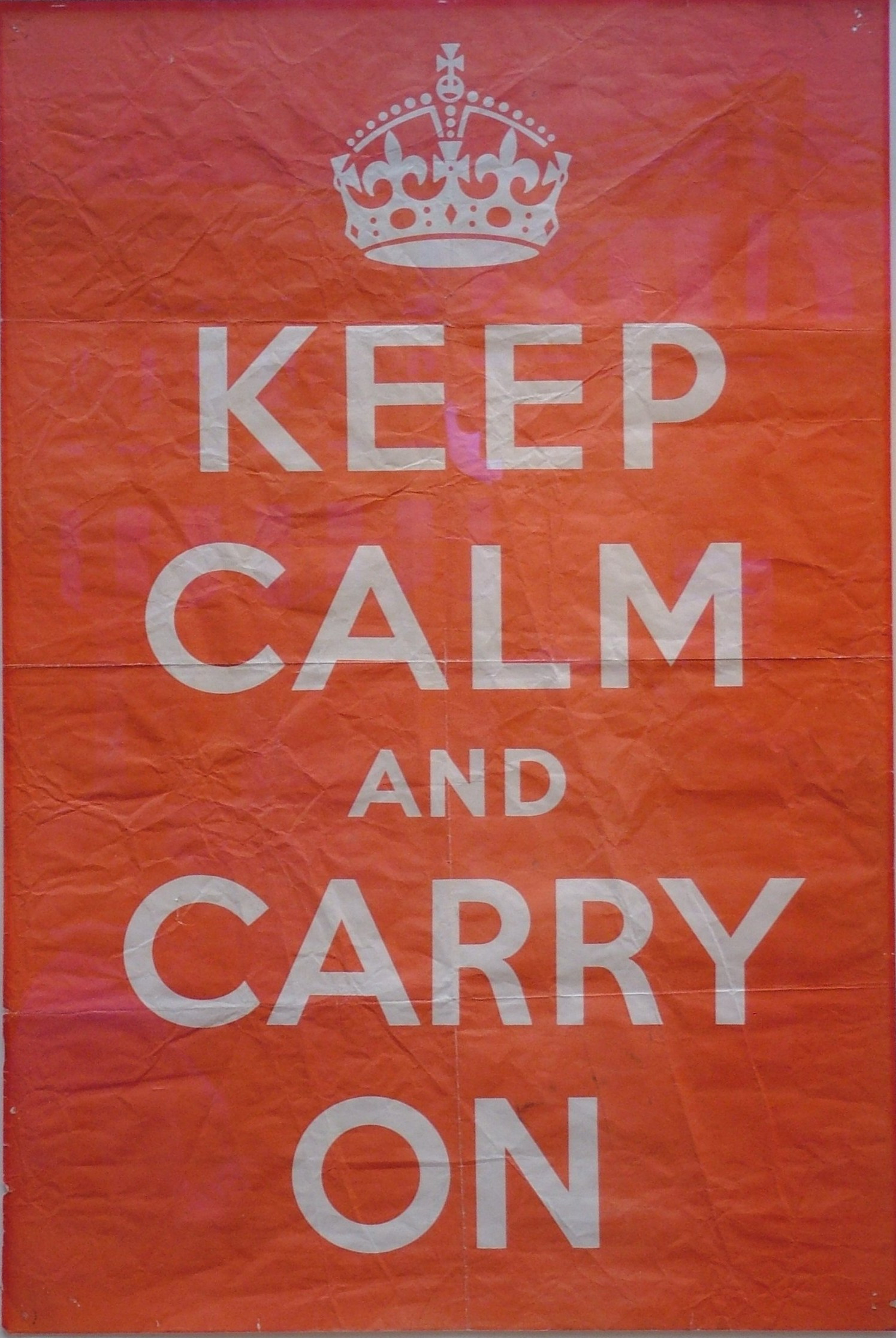
Write down five phrases people say to end an argument. For each, write the question it is usually used to avoid.
In the wild
Short examples of the technique at work, each with what to notice. The same examples are questions in the quiz, where the answer is not given away.
"Why did the rollout fail?" "Look, it is what it is. Let's move on."
What to notice. The question is closed with a formula that answers nothing; "let's move on" enforces the closure.
"Are we sure this is legal?" "Everyone's doing it. That's just how the industry works."
What to notice. Two stop signs in a row. The bandwagon note is there, but the function is to end the question.
"Why do we spend more on this than any other department?" "You can't argue with success."
What to notice. A cadence of conclusion with no content; whether the spending produced the success is untouched.
Sources
- Lifton, Robert Jay. Thought Reform and the Psychology of Totalism. New York: W. W. Norton, 1961. ISBN 978-0807842539
- Orwell, George. Nineteen Eighty-Four. London: Secker & Warburg, 1949.
- Hassan, Steven. Combating Cult Mind Control. Rochester: Park Street Press, 1988. ISBN 978-0892812431
- Lutz, William. Doublespeak. New York: Harper & Row, 1989. ISBN 978-0060161347