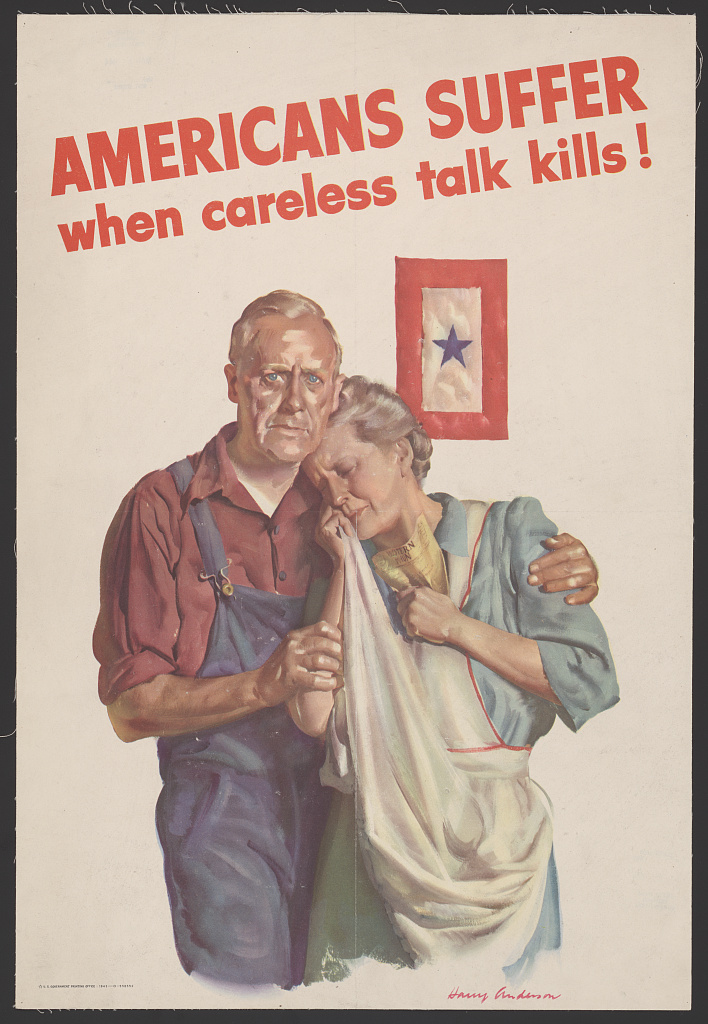
Americans suffer when careless talk kills!
 1
2
3
4
Library of Congress · LC-DIG-ppmsca-42064 (digital file from original item) · Public domain · Catalog record
The pins
Context
For discussion
-
1
Oversimplification The headline From a careless remark to a dead son in one line. The headline asserts the chain of cause and leaves every link for the viewer to imagine.
-
2
Appeal to pity The mother A mother weeps into a telegram, her husband holding her. The grief is painted like a magazine cover, which is the painter's trade.
-
3
Transfer The service flag The blue-star flag in the window meant a son serving. Every home with one would read the poster as about itself.
-
4
Appeal to fear The father's eyes The father looks straight at the viewer. The fear sold is not of the enemy but of being the one who caused this.
Harry Anderson's painting for the Office of War Information, 1943. A father in overalls holds a mother who weeps into a telegram, a blue-star service flag on the wall behind them: the son is overseas, and the news has come. The chain of cause from a stranger's remark to this kitchen is asserted in the headline and left to the viewer. Anderson was a magazine illustrator, and the poster is painted like a magazine cover.
- Follow the chain from "careless talk" to "Americans suffer." How many links are missing?
- What does the exclamation mark do?
- Why might a routine poster be more revealing than a famous one?
See also
Same era, or the same techniques.