I want YOU for U.S. Army
 1
2
3
4
Library of Congress · File:Unclesamwantyou.jpg · Public domain · Catalog record
The pins
Part of a case study
Context
For discussion
-
1
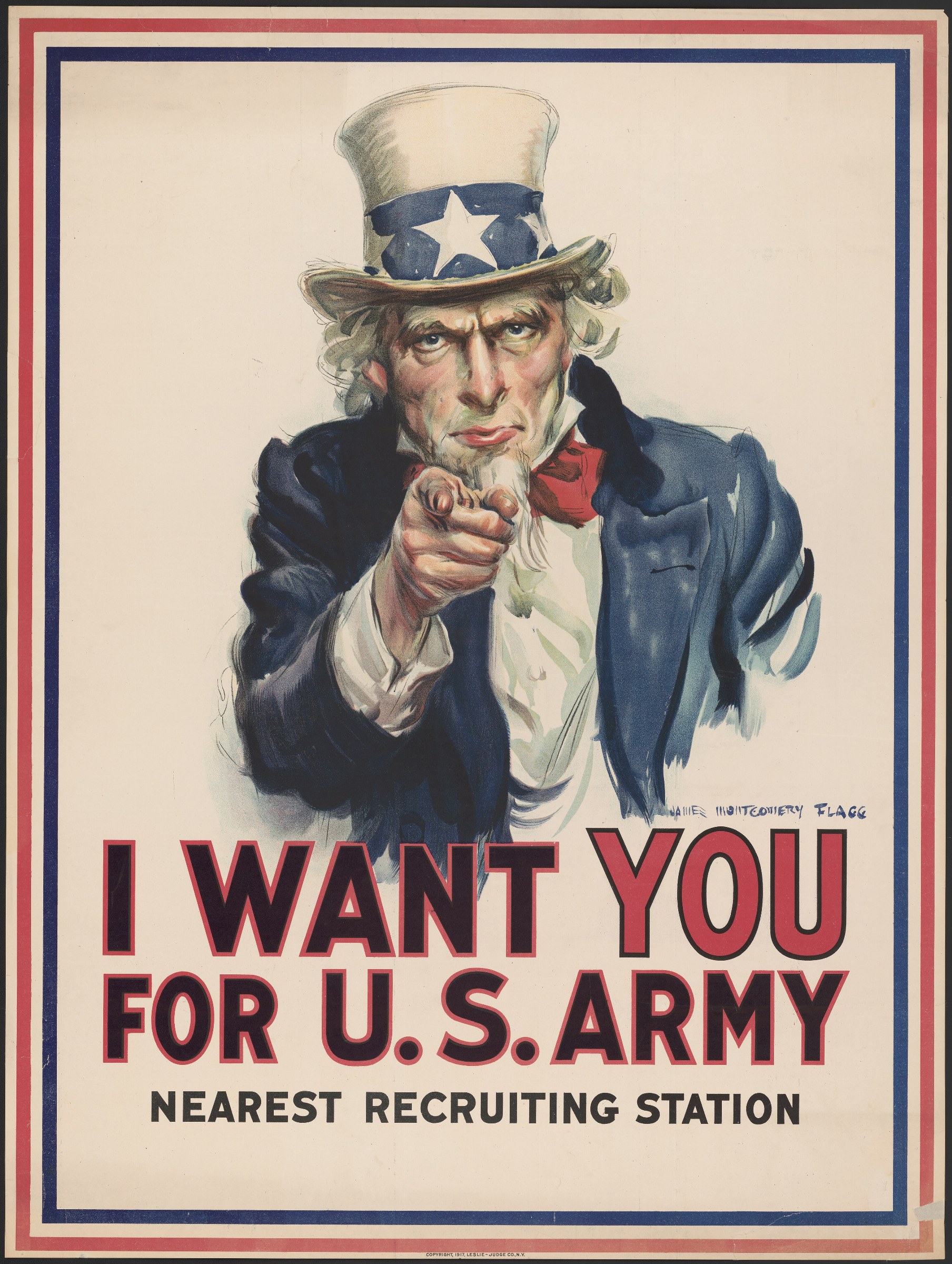
Transfer The hat Stars on the hatband, red bow tie, white hair: the flag worn as a costume. The nation is turned into a person whose feelings the viewer can hurt.
-
2
Appeal to authority The pointing finger The finger and the stare are drawn to follow the viewer wherever he stands. The country is not asking; it is giving an order, and it is giving it to you in particular.
-
3
Slogan I WANT YOU Four words, with "YOU" in red. Flagg copied the formula from Leete's Kitchener poster of 1914; it was printed about four million times and reused for the next war.
-
4
Flag-waving The border Red, white, and blue frame the whole sheet. Before the words are read, the colors have said that this is what patriotism looks like.
From Kitchener to Uncle Sam 1914–1917 · Recruitment
James Montgomery Flagg's Uncle Sam first appeared on the cover of Leslie's Weekly in July 1916 under the words "What are you doing for preparedness?" and was reissued as a recruiting poster in 1917; about four million copies were printed in the war. The pose copies Alfred Leete's 1914 Kitchener poster, "Your country needs YOU." Flagg used his own face, aged, as the model, and the poster was reprinted for the Second World War.
- The pointing finger and the direct stare follow the viewer. What does it change when a national symbol addresses you personally?
- Flagg copied the pose from a British poster of Lord Kitchener. Why swap a general for Uncle Sam?
- What is the difference between "I want you" and "Your country needs you"?
See also
Same era, or the same techniques.