A year of the proletarian dictatorship
 1
2
3
4
5
Other · File:Soviet propaganda poster, proletarian dictatorship 1918.jpg · Public domain · Catalog record
The pins
Context
For discussion
-
1
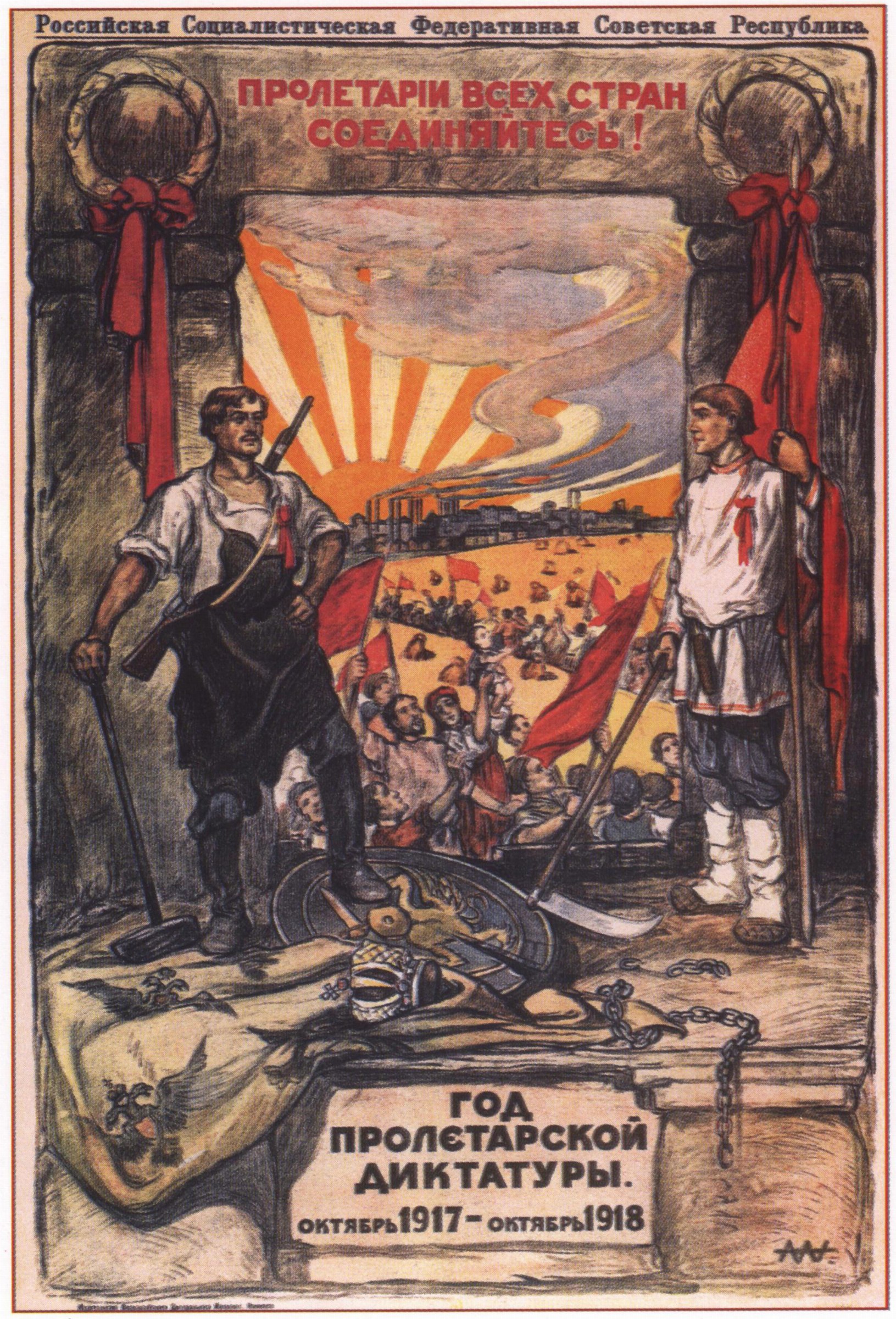
Slogan The headline "Proletarians of all countries, unite!" The last line of the Communist Manifesto, printed on every Soviet poster and newspaper for seventy years until it meant nothing more than a masthead.
-
2
Glittering generalities The rising sun Factories, fields, and a sunrise: the future as a landscape nobody has to describe. The sun is doing the work that an argument would.
-
3
Plain folks The worker An ordinary workman in an apron, rifle slung, as the hero of the state. The peasant opposite is his equal in height and dress, which in 1918 was a claim rather than a fact.
-
4
Us versus them The broken crown and eagle The crown, the double-headed eagle, the shield, and the chains lie in a heap at the workers' feet. The old order is not argued against; it is shown as junk.
-
5
Historical revisionism The caption "A year of the proletarian dictatorship, October 1917 to October 1918." The year had brought civil war, famine, and the Red Terror; the poster shows a procession into the sunrise.
Alexander Apsit's poster for the first anniversary of the October revolution, November 1918, the first large-scale Bolshevik poster and the model for hundreds that followed. A worker and a peasant stand on either side of a doorway hung with the broken chains, crown, and double-headed eagle of the old order, looking out over a land of factories, fields, and a rising sun. Apsit painted it in a style borrowed from prewar commercial lithography and religious icons.
- The crown and the eagle lie broken at the bottom of the picture. What does this placement say about the year that has passed?
- The worker and the peasant look alike. What was the poster claiming about them?
- Why does a revolutionary poster look so much like a church icon?
See also
Same era, or the same techniques.