Dig on for victory
 1
2
3
4
National Archives · File:INF3-96 Food Production Dig for Victory Artist Peter Fraser.jpg · Public domain · Catalog record
-
1
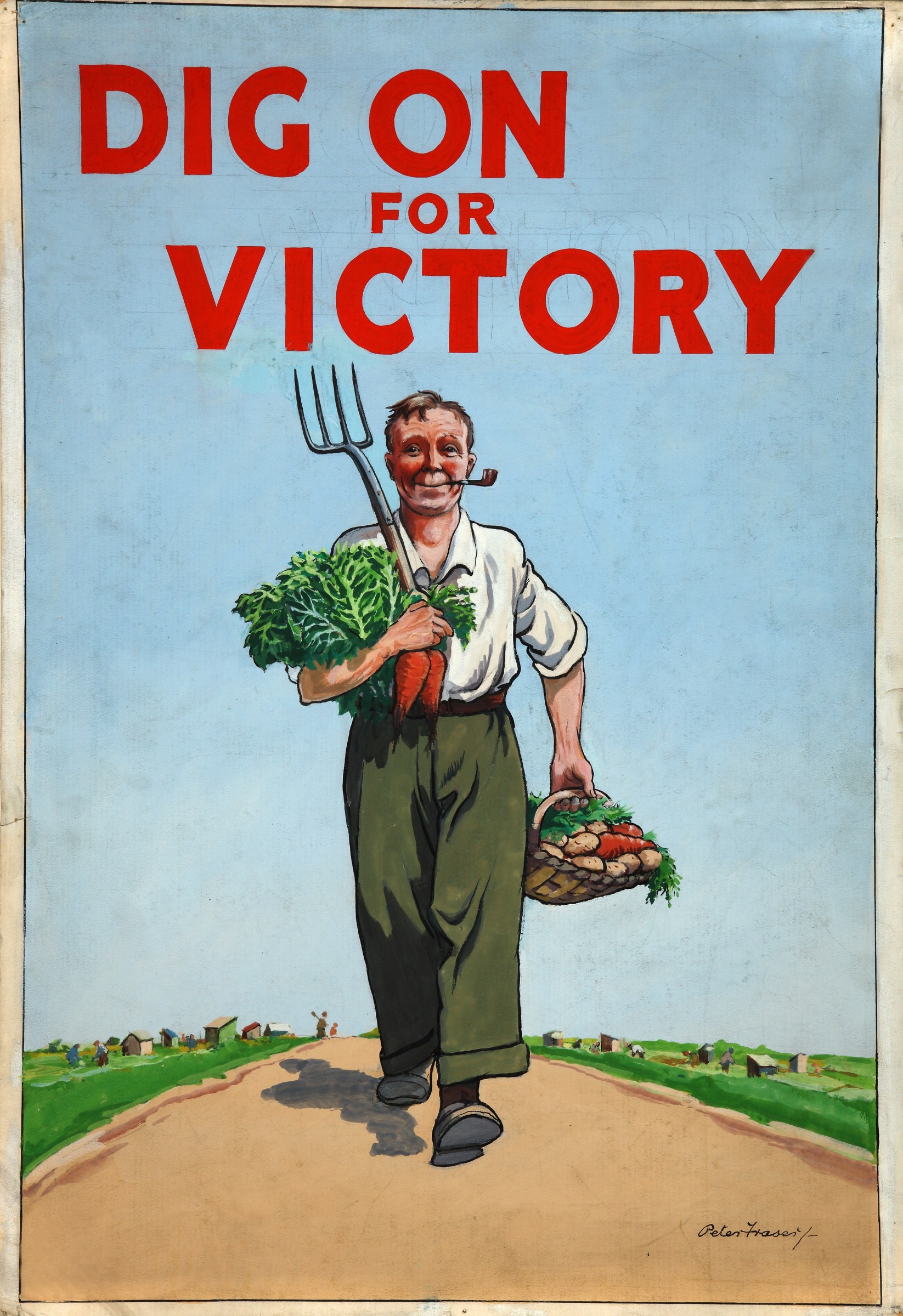
Slogan The headline "Dig on": the campaign's second-year line, asking people who had dug once to keep going. The word "victory" does the work of explaining why.
-
2
Plain folks The man Shirt sleeves, braces, a pipe, a smile. The gardener is every man in the street, and the street is where the poster hung.
-
3
Glittering generalities The vegetables A cabbage, carrots, and a full basket. Plenty is shown; the rationing that made the campaign necessary is not.
-
4
Bandwagon The allotments Sheds and figures digging on both sides of the path. Everyone else is already at it.
Peter Fraser's poster for the Ministry of Agriculture's "Dig for Victory" campaign, which from October 1939 turned parks, lawns, and railway embankments into allotments. Britain imported most of its food before the war, and the U-boat campaign made home growing a matter of survival; by 1943 there were about 1.4 million allotments. "Dig on" was the campaign's second-year line, asking people who had dug once to keep at it; Fraser's man comes up the path with a fork over his shoulder, a cabbage and carrots under his arm, a pipe in his mouth, and allotments on either side.
- Compare this with "Food will win the war." Why is the British version so much plainer?
- The man is smiling, with a pipe. What is the poster saying about how hard this is?
- Which is doing more work here, the picture or the slogan?
See also
Same era, or the same techniques.