Your face looks so familiar
 1
2
3
4
Library of Congress · LC-DIG-ppmscd-05392 (digital file from original) · Public domain · Catalog record
The pins
Context
For discussion
-
1
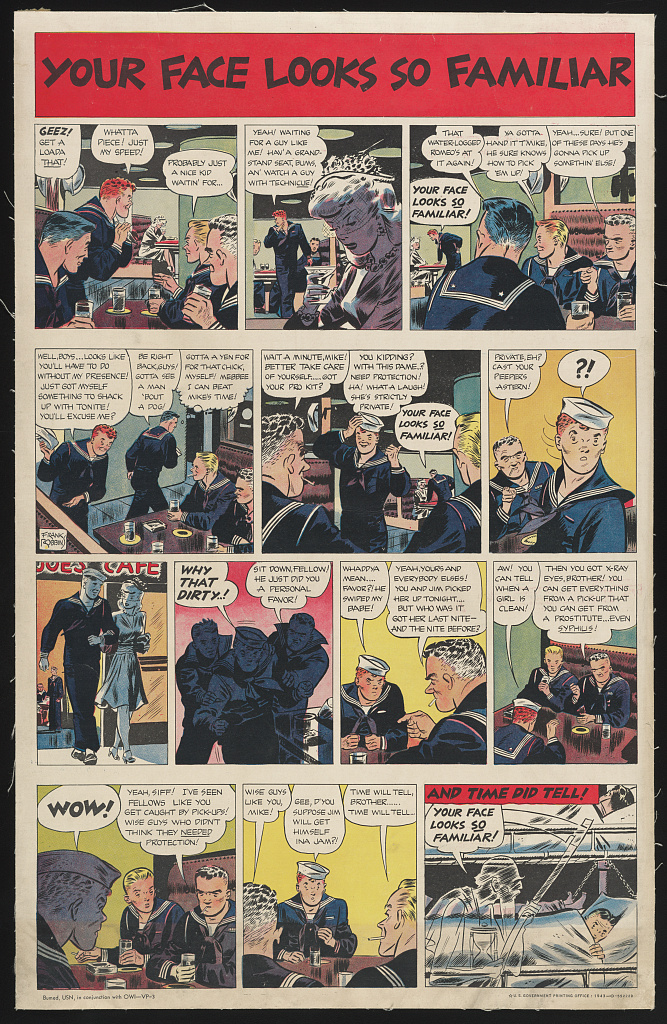
Repetition The title The pick-up line is the title, the refrain, and the last panel's punchline. Repetition turns a stranger's compliment into a warning sign.
-
2
Stereotyping The woman The "pick-up girl" of the Public Health Service campaign: a type, not a person, and the type was blamed for disease the soldiers also carried.
-
3
Appeal to authority The lecture The shore patrol officer explains prophylaxis in a speech balloon. Medicine is delivered as an order, in uniform.
-
4
Appeal to fear The hospital bed The last panel: the sailor in bed, "and time did tell." A comic strip ends with the moral; this one ends with a diagnosis.
Frank Robbins's poster for the Public Health Service's wartime venereal disease campaign, 1943. Robbins was a comic-strip artist, and the poster is a full comic strip in sixteen panels: sailors in a bar, a pick-up, a shore-patrol officer's lecture on prophylaxis, and in the last panel the sailor in a hospital bed with the line in the title. The campaign treated the "pick-up girl" as the vector of disease, a framing that put the blame on civilian women and led to the detention of thousands of them under wartime health laws.
- Who is the warning aimed at, and who is blamed?
- Why borrow the comic strip?
- Public health posters are propaganda for a good cause. Does that make them a different thing?
See also
Same era, or the same techniques.