Appeal to authority
Offering the rank, title, or institutional standing of a source as the reason to accept a claim, in place of the evidence the source would need to be right.
Deference is a shortcut we cannot do without. No one can check everything, so we trust the doctor about the dose and the engineer about the bridge, and most of the time that trust is well placed. The device exploits the shortcut by supplying the signal of authority, a title, a uniform, a letterhead, a laboratory, without the substance, or by carrying a real authority outside its field. The audience defers as usual; the claim gets in unexamined.
Stanley Milgram's obedience experiments showed how far a lab coat and a calm voice could take people against their own judgment. Propaganda rarely needs to go that far; it needs only to make questioning feel presumptuous. Where testimonial borrows a person's fame, this device borrows a role's standing. Exploits Authority Bias and Halo Effect.
Historical examples
Alfred Leete's image of Lord Kitchener, first published on the cover of London Opinion in September 1914 and reproduced on recruiting posters, put the Secretary of State for War's face, moustache, and pointing finger above the words "Your Country Needs YOU." The poster makes no argument for the war; it delivers an instruction from the highest military authority in the country directly to the individual reader.
Taylor, James. Your Country Needs You: The Secret History of the Propaganda Poster. Glasgow: Saraband, 2013; Imperial War Museums, First World War poster collection.
Milgram's experiments at Yale found that most participants would administer what they believed were dangerous electric shocks to a stranger when instructed to by an experimenter in a gray coat. The authority was a costume and a tone of voice. The finding is the mechanism of this device measured in a laboratory.
Milgram, Stanley. "Behavioral Study of Obedience." Journal of Abnormal and Social Psychology 67, no. 4 (1963): 371–378; Milgram, Stanley. Obedience to Authority: An Experimental View. New York: Harper & Row, 1974.
In advertising and commerce
The Tobacco Industry Research Committee announced in 1954 that it would be guided by a Scientific Advisory Board of "distinguished scientists," and the industry cited the board's existence for four decades as proof that the science was being taken seriously. The board's standing was the message; its funding source and the questions it was steered away from were not.
Brandt, Allan M. The Cigarette Century. New York: Basic Books, 2007; Proctor, Robert N. Golden Holocaust: Origins of the Cigarette Catastrophe and the Case for Abolition. Berkeley: University of California Press, 2011.
In the archive
Posters and advertisements annotated with this technique.
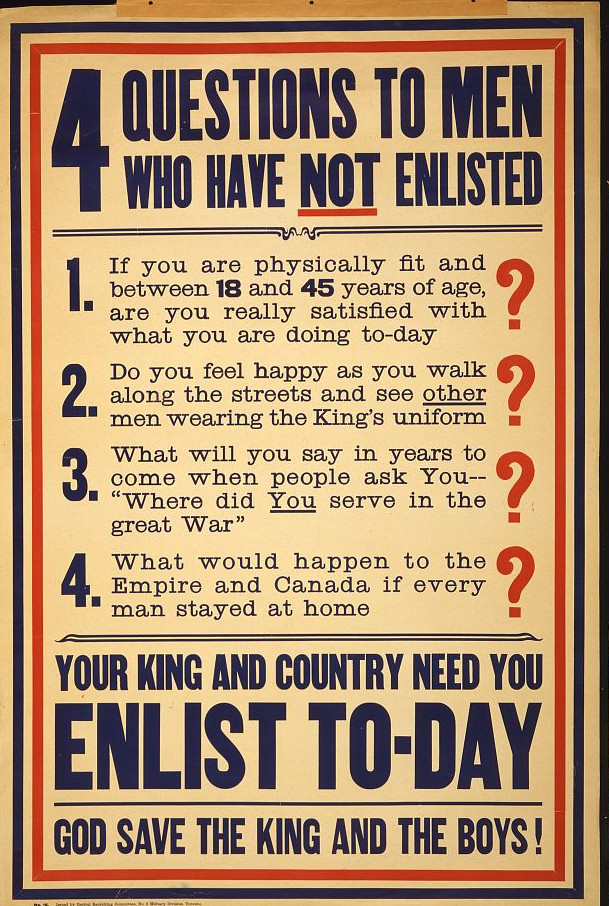 4 questions to men who have not enlisted
Canada · 1915 · 5 techniques annotated
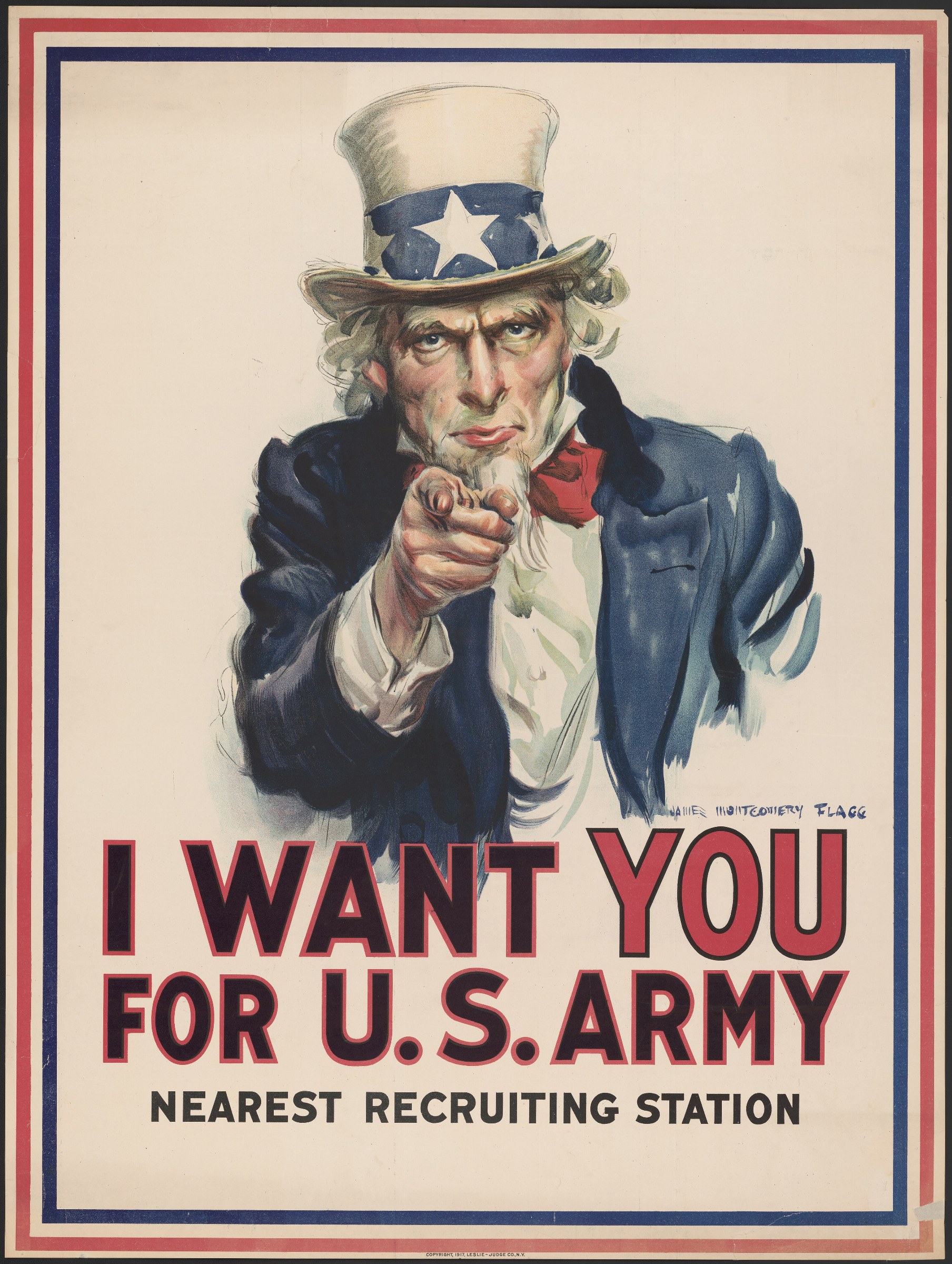 I want YOU for U.S. Army
United States · 1917 · 4 techniques annotated
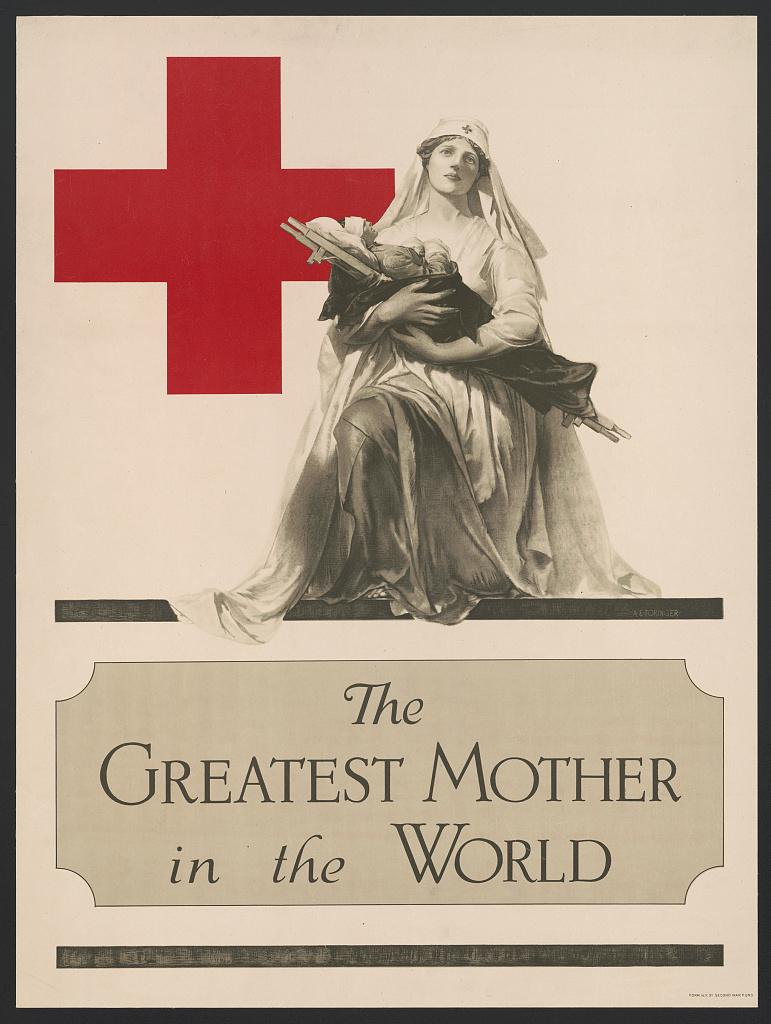 The greatest mother in the world
United States · 1918 · 4 techniques annotated
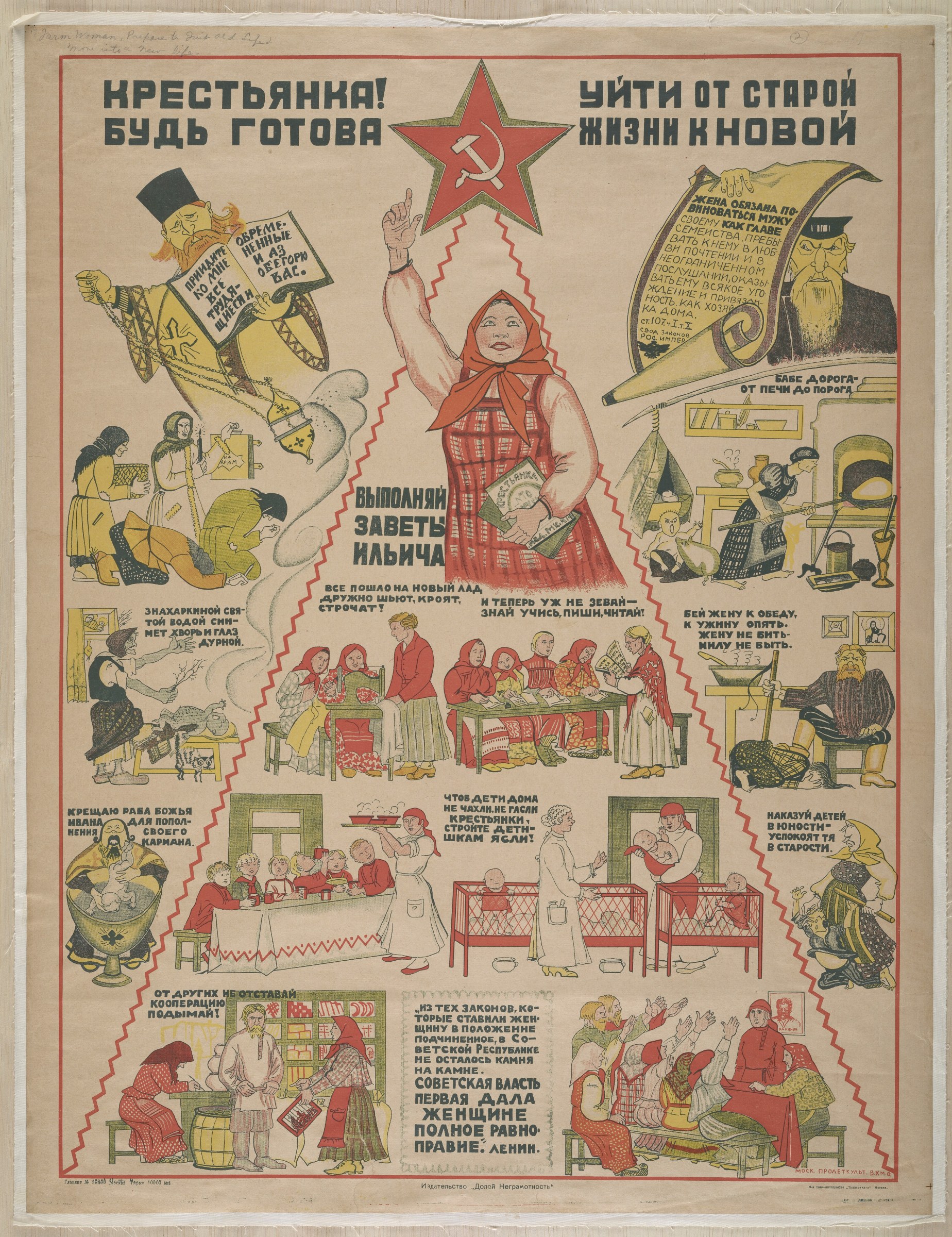 Peasant woman! Be ready to leave the old life for the new
Soviet Union · 1925 · 5 techniques annotated
Find a claim this week that rests on "experts," "studies," or an official title. Who, specifically? Could you find them? Are they experts in this?
In the wild
Short examples of the technique at work, each with what to notice. The same examples are questions in the quiz, where the answer is not given away.
"Leading economists have confirmed that the tax will pay for itself." No economist is named.
What to notice. The standing of an unnamed profession is the whole support for the claim.
"As a former general, I can tell you this school curriculum is a national security risk."
What to notice. A real authority carried outside its field; the rank is offered as the reason to accept the claim.
A skincare advertisement shows a laboratory, beakers, and the words "clinically formulated." No study is cited.
What to notice. The props of science and the word "clinically" borrow institutional authority without any evidence attached.
Sources
- Milgram, Stanley. Obedience to Authority: An Experimental View. New York: Harper & Row, 1974. ISBN 978-0061765216
- Cialdini, Robert B. Influence: The Psychology of Persuasion. New York: William Morrow, 1984. ISBN 978-0061241895
- Taylor, James. Your Country Needs You: The Secret History of the Propaganda Poster. Glasgow: Saraband, 2013. ISBN 978-1908643056
- Proctor, Robert N. Golden Holocaust. Berkeley: University of California Press, 2011. ISBN 978-0520270169