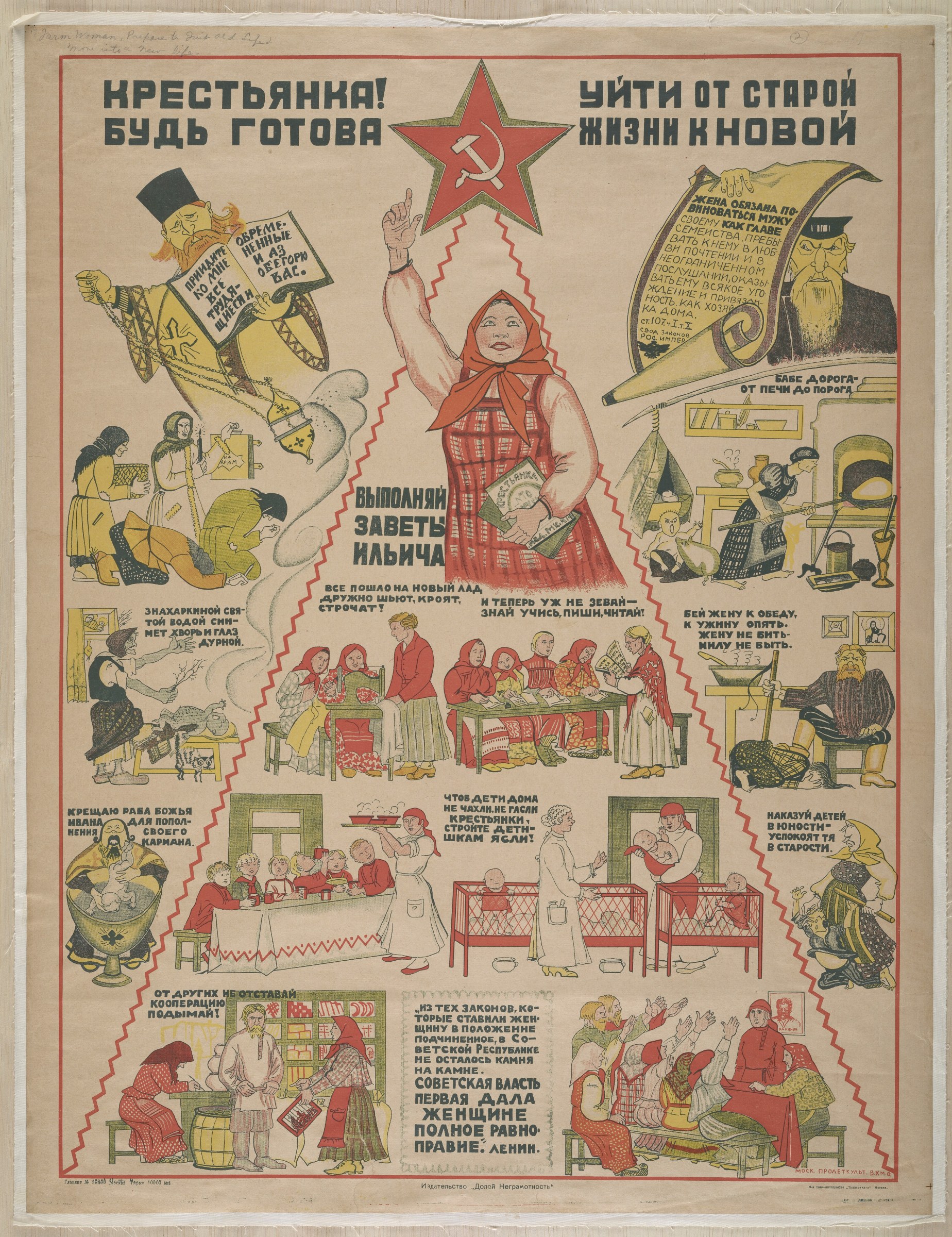
Peasant woman! Be ready to leave the old life for the new
 1
2
3
4
5
Other · File:Idn.duke.edu Soviet propaganda poster 1920s - Peasant Woman Leave old life behind embrace the new Крестьянка! Будь готова уйти от старой жизни к новой No known copyright.jpg · Public domain · Catalog record
The pins
Context
For discussion
-
1
Stereotyping The priest A priest in yellow with a chain and censer, swaying over kneeling women. Every figure of the old life is drawn as a type the viewer already dislikes.
-
2
Appeal to outrage The law scroll A bearded patriarch holds the imperial law code, article 107: "The wife is obliged to obey her husband as the head of the family." The quotation is real, and chosen to anger.
-
3
Cult of personality "Carry out Ilyich's testaments" Lenin by his patronymic, as family. The new life is not a program to be weighed but the wish of a dead man to be honored.
-
4
Card stacking The beating The old life is the stove, the icon, and the fist; the new life is the reading room and the nursery. Nothing good is shown on the old side, and nothing hard on the new.
-
5
Appeal to authority The Lenin quotation "Soviet power was the first to give women full equality. Lenin." The claim is closed with a signature rather than evidence.
A Soviet poster of the 1920s addressed to peasant women, from the Duke University Libraries collection. On one side the old life: the icon, the cradle, the stove, the husband's fist. On the other the new: the reading room, the nursery, the cooperative, the meeting. The Zhenotdel, the party's women's department, ran campaigns like this through the decade, selling literacy and the end of the patriarchal household as a single package with the regime.
- The old life is drawn dark and the new one light. What is left out of each?
- Who is speaking to the peasant woman, and what do they want from her?
- Before-and-after is a format advertising also uses. What makes it persuasive?
See also
Same era, or the same techniques.