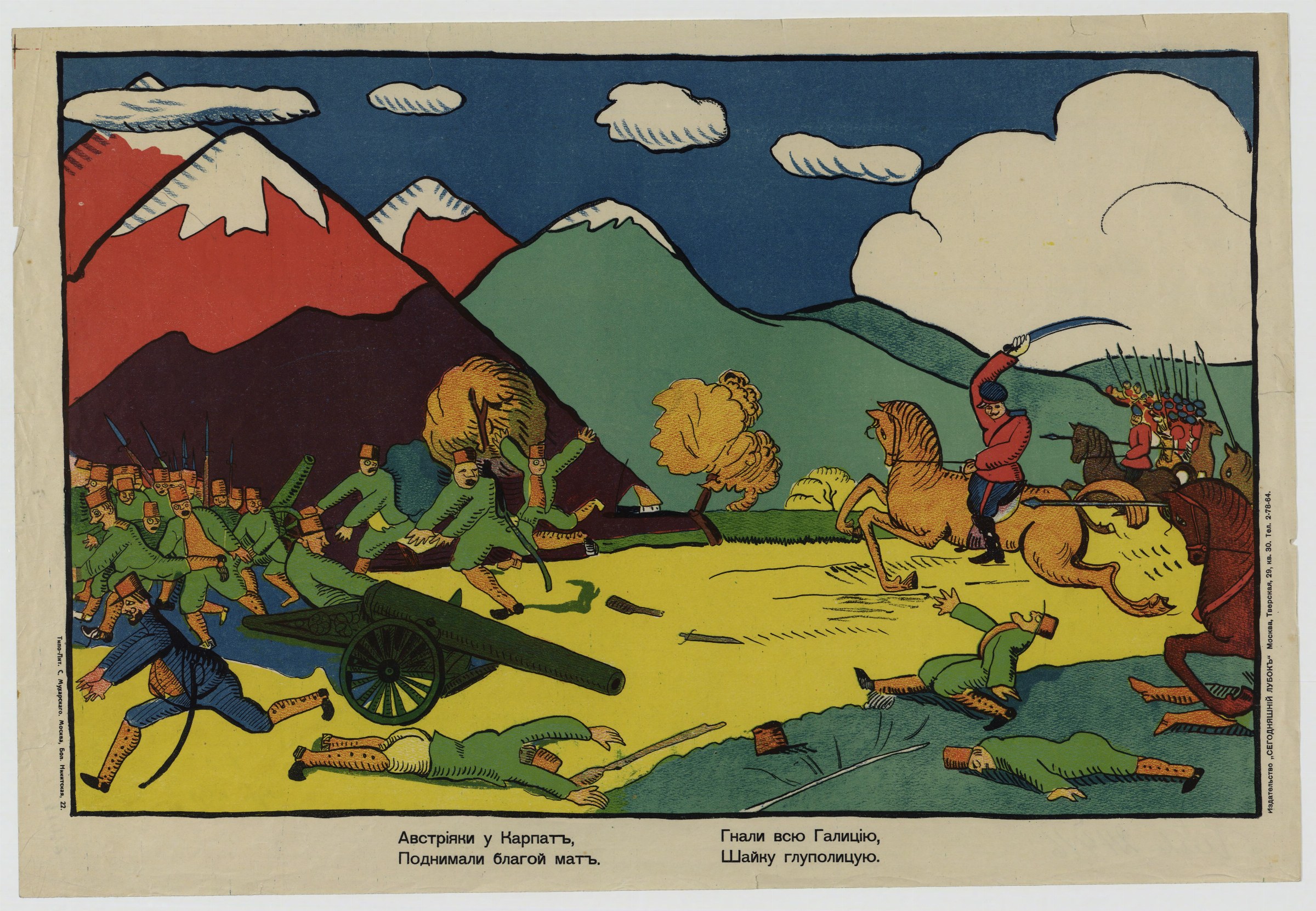
The Austrians cursed loudly near the Carpathian Mountains
 1
2
3
4
Library of Congress · Public domain · Catalog record
The pins
Context
For discussion
-
1
Caricature The fleeing Austrians Fez-like caps, round faces, arms flailing, one on his back. The enemy is a troupe of clowns, drawn to be laughed at rather than feared.
-
2
Glittering generalities The Cossack Red coat, raised saber, rearing horse: the Russian soldier as a figure from a folk tale. No mud, no wounds, no retreat, all of which the Carpathian front had that winter.
-
3
Plain folks The bright mountains The lubok was the cheap colored print peasants pinned up at home. Mayakovsky used the people's own picture style to tell them the war was going well.
-
4
Name-calling The rhyme "Chased all over Galicia the stupid-faced gang." The rhyme makes an insult memorable, and memorable insults are repeated.
A lubok, a popular print, from the autumn of 1914, drawn and captioned by the 21-year-old Vladimir Mayakovsky for the Moscow publisher Segodnyashny Lubok. Russian soldiers chase a tumbling Austrian army over the mountains in flat bright color with a rhymed caption. Six years later Mayakovsky was writing the ROSTA windows for the Bolsheviks in the same format, which is the point of including it: the style changed sides before the artist did.
- The enemy is a clown. What does ridicule do that fear does not?
- Compare this with the ROSTA windows of 1920. What stayed the same?
- Why rhyme?
See also
Same era, or the same techniques.