Join the Navy, your country needs you
 1
2
3
4
Library of Congress · LC-USZC4-7758 (color film copy transparency) · Public domain · Catalog record
The pins
Context
For discussion
-
1
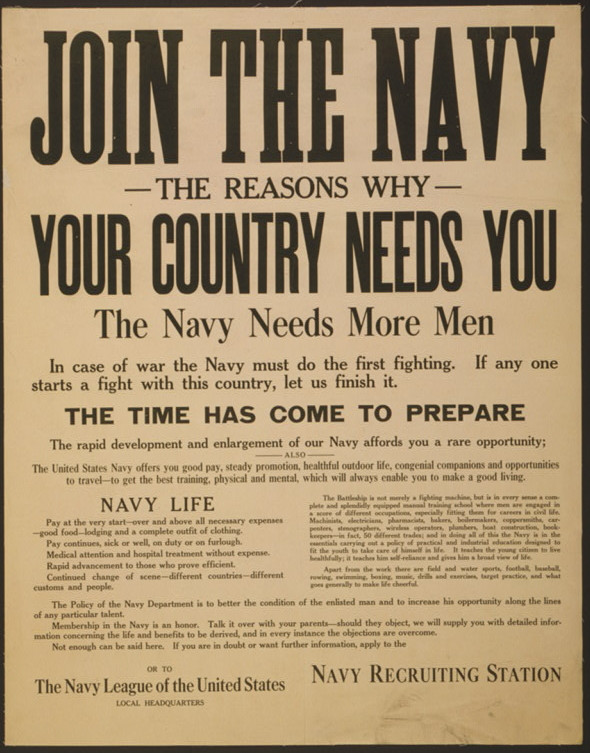
Slogan Your country needs you The Kitchener formula of 1914, now in an American typeface. By 1917 the phrase needed no picture; it had become a slogan that carried its own poster in the reader's head.
-
2
Appeal to fear If any one starts a fight with this country The enemy is "any one" and the threat is a fight someone else starts. Vague enough to be certain, and the only line on the sheet about war at all.
-
3
Glittering generalities Navy Life Pay, food, lodging, medical care, promotion, "continued change of scene." Naval service described as a job with a travel allowance.
-
4
Card stacking The right-hand column Fifty trades, sports, music, "a broad view of life." Everything the Navy offers is listed and nothing it asks for is. The sheet is honest in every line and misleading as a whole.
A text-only Navy recruiting broadside of 1917, headed "The reasons why." It promises pay from the first day, food, lodging, a full outfit of clothing, medical care, travel, and training in fifty trades, and tells the reader that "in case of war the Navy must do the first fighting." Membership "is an honor," and the reader is told to talk it over with his parents, whose objections the recruiter will answer. Danger is mentioned nowhere.
- Count the benefits listed and the risks listed. What does the ratio tell you?
- "If any one starts a fight with this country, let us finish it." Who is "any one," and why is it left vague?
- The sheet tells the reader to talk it over with his parents and promises to answer their objections. Why include the parents?
See also
Same era, or the same techniques.