Caricature
Drawing a person or class with its features exaggerated into a type, the banker's belly, the priest's jowls, the enemy leader's mustache, so that the type is recognized before the argument, and the argument is the type.
A caricature is a label that can be seen across a street. Once an audience has learned that a top hat and a cigar mean "capitalist," every drawing of a top hat is an argument about capital, and the argument cannot be answered because it was never stated. The device does its best work on classes rather than individuals: a stock figure for the landlord, the priest, or the foreigner can be used for a decade, and each use teaches the next.
Caricature of a leader is older and more honest, since the subject is named; Gillray's Napoleon and Low's Hitler were ridicule with a target. The stock figure has no target, which is why it is the more dangerous form. Exploits Representativeness Heuristic and Out Group Homogeneity.
Historical examples
James Gillray's "Little Boney" prints drew Napoleon as a tiny, strutting figure in an oversized hat and boots, a type that British caricature kept for the rest of the war and that has outlived the man: the short Napoleon is Gillray's invention, not a fact. Napoleon reportedly complained of Gillray at the peace talks of 1802.
Bryant, Mark. Napoleonic Wars in Cartoons. London: Grub Street, 2009; Hill, Draper. Mr. Gillray, the Caricaturist. London: Phaidon, 1965.
Thomas Nast's Harper's Weekly cartoons drew William Tweed as a bloated figure with a money-bag for a head, and the Tammany ring as vultures; Tweed is said to have told his associates that his constituents could not read but could see the pictures. The drawings helped bring down the ring, and when Tweed fled to Spain he was identified from a Nast cartoon.
Halloran, Fiona Deans. Thomas Nast: The Father of Modern Political Cartoons. Chapel Hill: University of North Carolina Press, 2012.
Viktor Deni and the ROSTA artists carried the prerevolutionary satirical magazines' stock figures into the poster: the capitalist in a top hat, the priest with a censer, the kulak with a sack. Deni's "At the Grave of the Counter-Revolution" has the whole cast weeping at once. The types outlived the civil war and were used for enemies of each later campaign.
Bonnell, Victoria E. Iconography of Power. Berkeley: University of California Press, 1997; White, Stephen. The Bolshevik Poster. New Haven: Yale University Press, 1988.
In the archive
Posters and advertisements annotated with this technique.
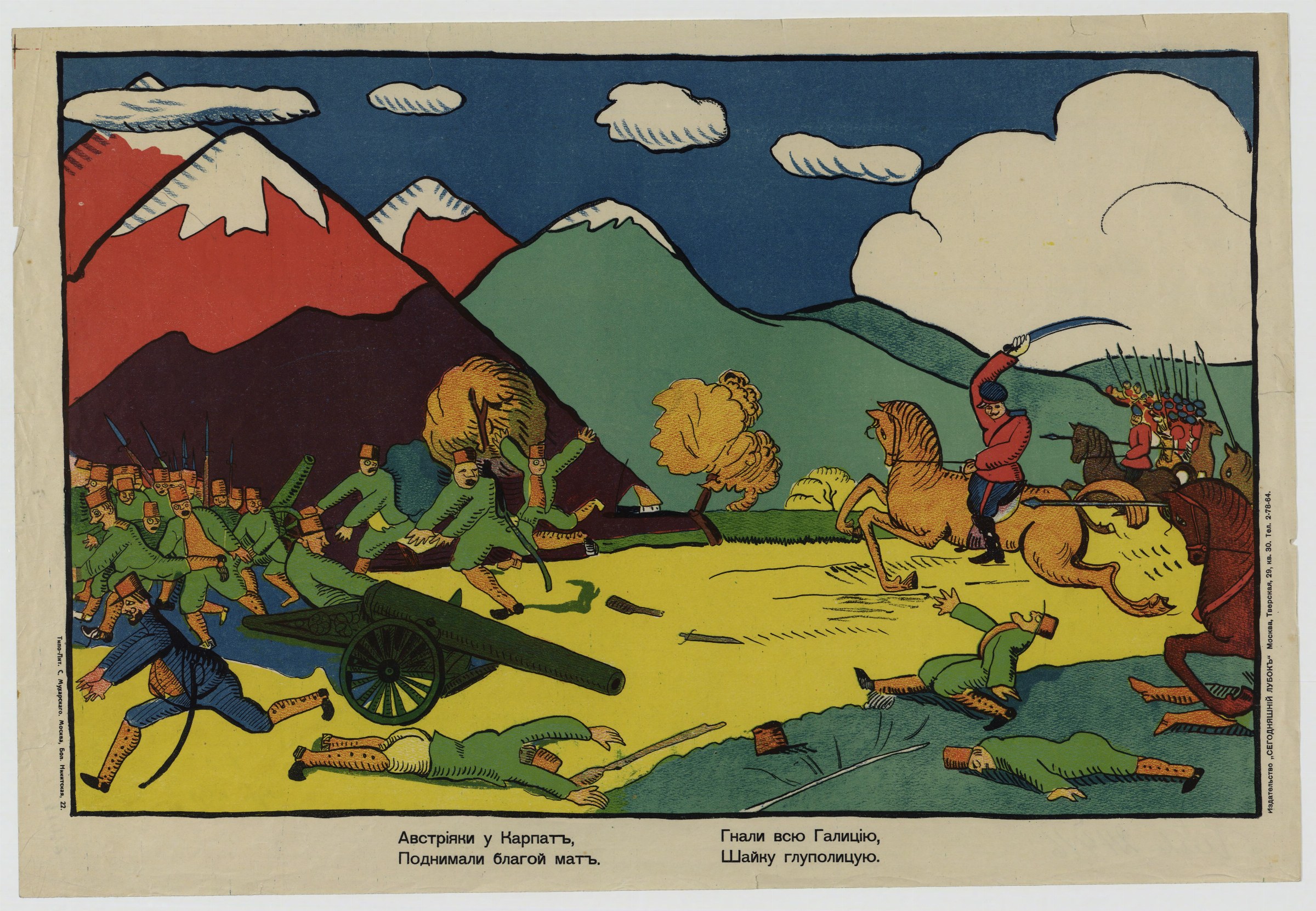
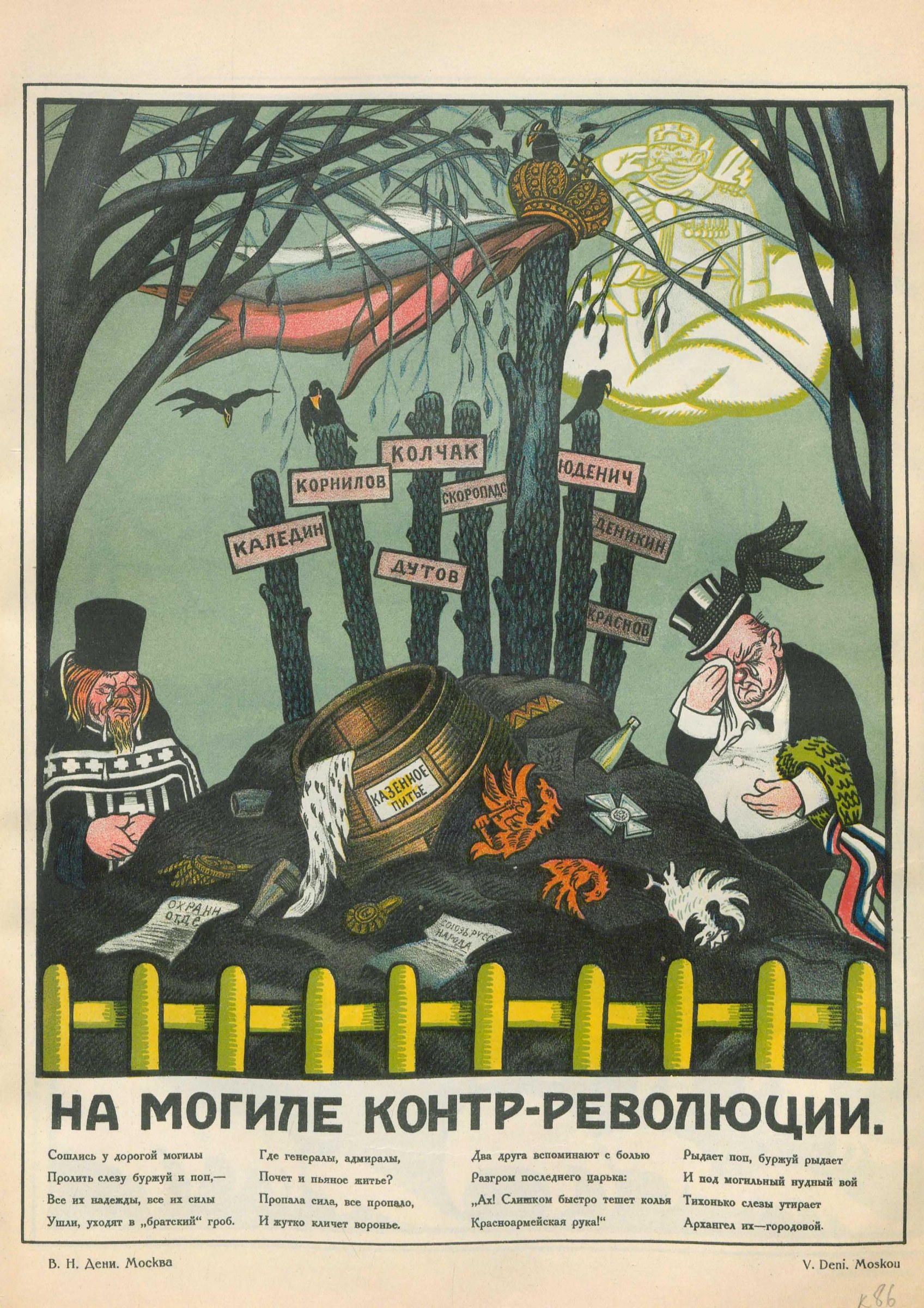
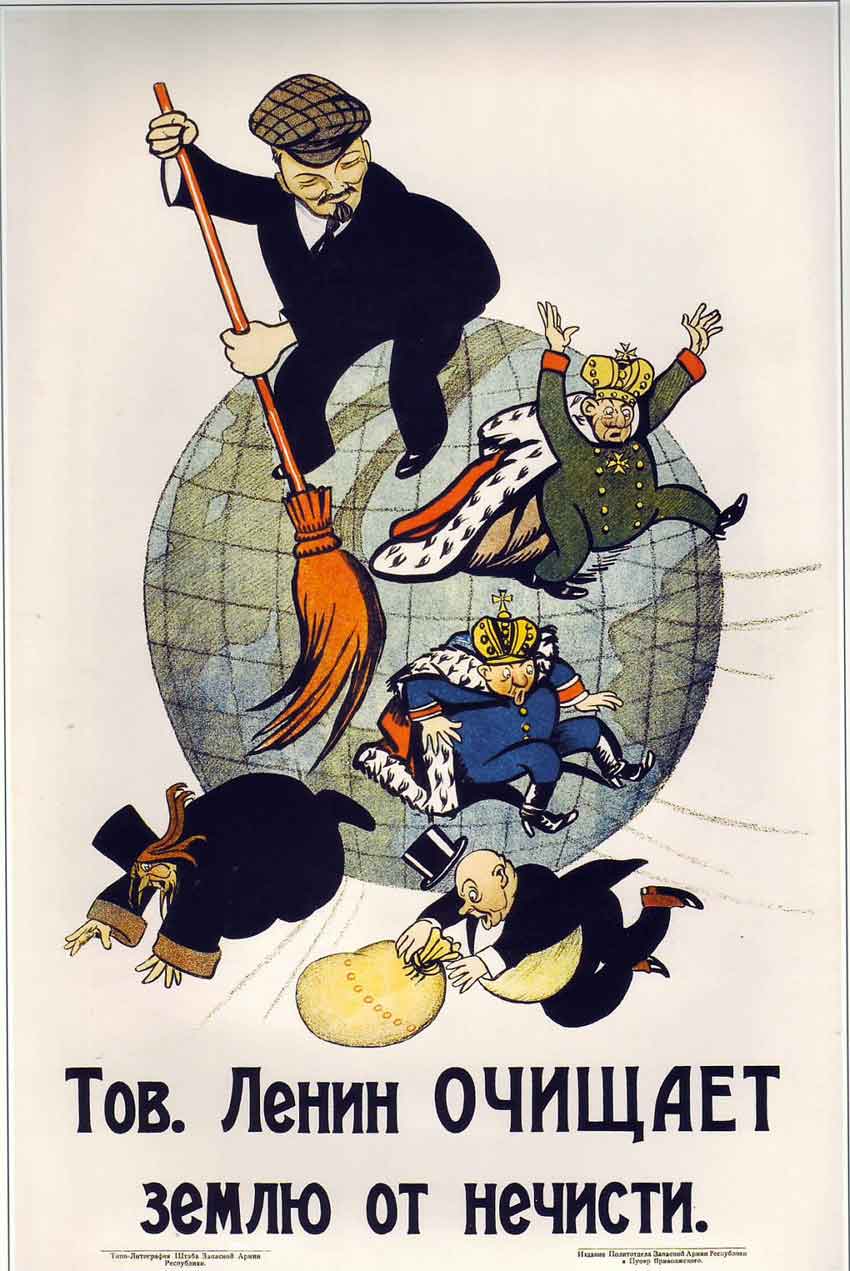
Find a cartoon in which a group is represented by one drawn figure. What features identify the group, and where did the cartoonist learn them?
In the wild
Short examples of the technique at work, each with what to notice. The same examples are questions in the quiz, where the answer is not given away.
A cartoon on tax policy shows "the rich" as one fat man in a top hat and spats, smoking a cigar, on every page of a pamphlet.
What to notice. One drawn type stands for a class; the drawing is the whole argument about the class.
Every picture of the opposing candidate in a party's newspaper is drawn with a receding chin and tiny hands, whatever the story.
What to notice. The exaggerated features are the case against him, repeated in place of one.
A poster shows the foreign landlord as a pig in a nobleman's coat, a type the same artist had used for other enemies the year before.
What to notice. A stock figure reused for a new target: the costume and the animal identify a class on sight.
Sources
- Gombrich, E. H. "The Cartoonist's Armoury." In Meditations on a Hobby Horse. London: Phaidon, 1963. ISBN 978-0714817125
- Halloran, Fiona Deans. Thomas Nast: The Father of Modern Political Cartoons. Chapel Hill: University of North Carolina Press, 2012. ISBN 978-0807835876
- White, Stephen. The Bolshevik Poster. New Haven: Yale University Press, 1988. ISBN 978-0300041392