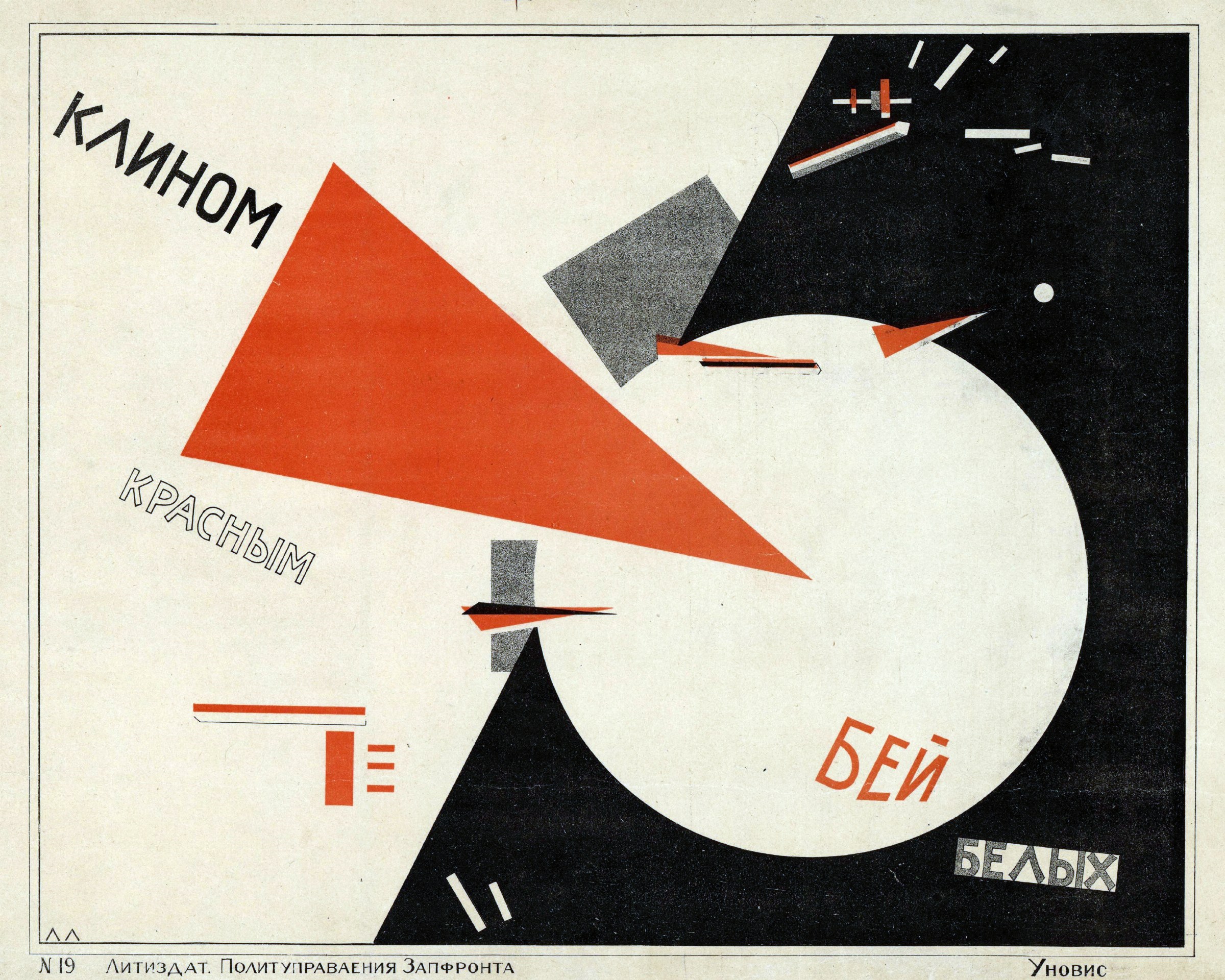
Beat the Whites with the Red Wedge
The pins
Context
For discussion
-
1
Us versus them The red wedge Red is sharp, active, and entering; white is round, passive, and pierced. Two sides of a civil war reduced to two shapes, with no doubt about which is alive.
-
2
Oversimplification The white circle Armies, regions, foreign backers, and a dozen rival governments become one white disc. Abstraction removes everything that would complicate the choice.
-
3
Slogan "Klinom krasnym" Four words scattered across the sheet so that the eye assembles them in the order of the attack. The sentence is the picture.
-
4
Labeling "Belykh" (the Whites) The enemy is a color. Monarchists, liberals, Cossacks, and foreign troops are all "the Whites," and a color cannot have a case.
El Lissitzky's lithograph of 1919–20, made in Vitebsk where he taught alongside Malevich. A red triangle drives into a white circle; the words are scattered across the sheet in the manner of the Suprematist painters. It was an argument that abstraction could serve the revolution, made by an artist who believed it, and it was far more admired later than it was effective at the time.
- The poster contains no soldier, no enemy, and no weapon. What is doing the persuading?
- Red and white were the names of the two sides. What does the picture add to the names?
- Would a peasant in 1920 have understood this? Does it matter?
See also
Same era, or the same techniques.