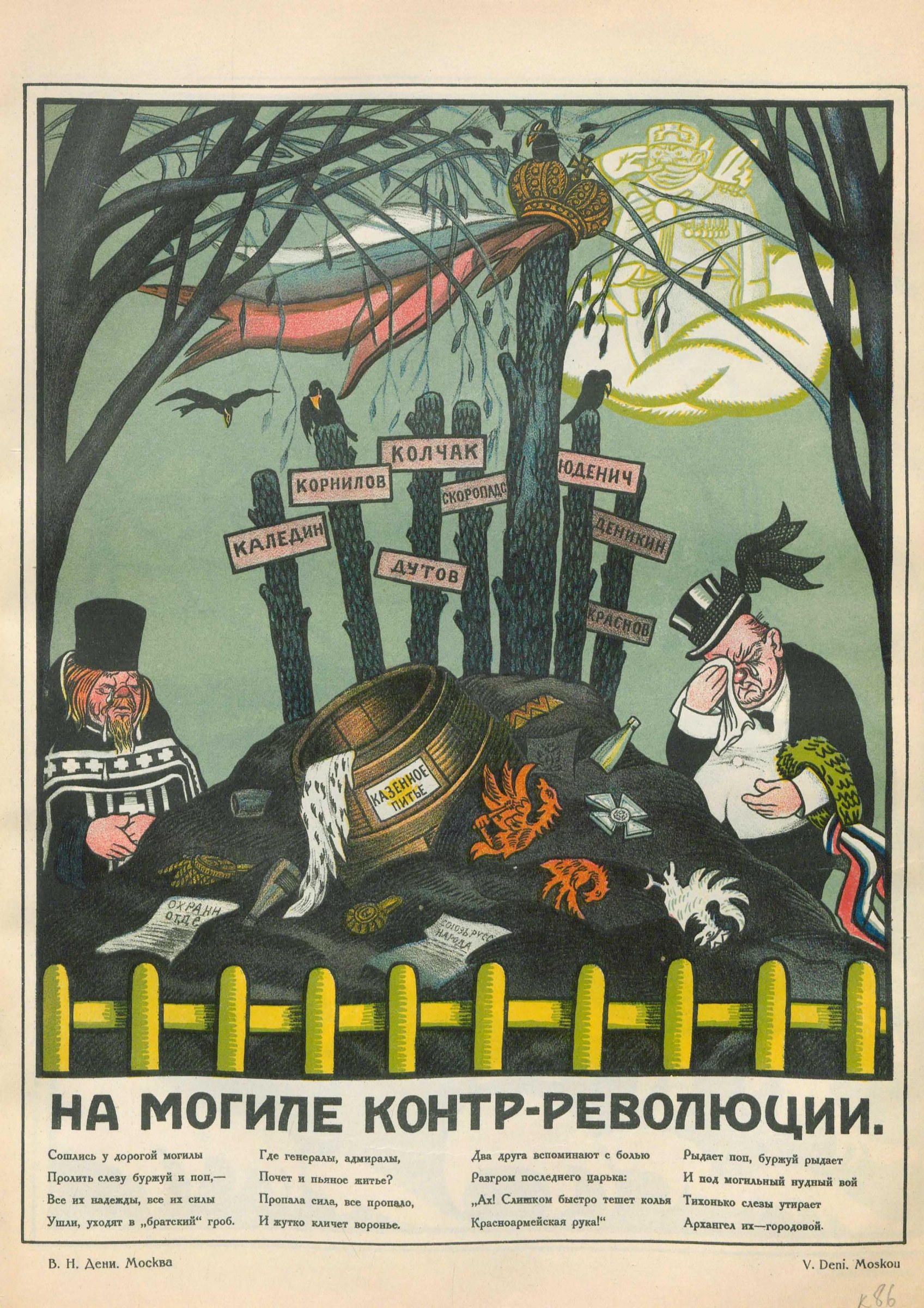
At the grave of the counter-revolution
 1
2
3
4
Other · File:Viktor Nikolaevich Deni - At the grave of the counter revolution.jpg · Public domain · Catalog record
The pins
Context
For discussion
-
1
Common enemy The priest A fat priest weeps at the grave. The church is placed among the mourners for the White generals, which made attacking the one the same as attacking the other.
-
2
Caricature The capitalist Top hat with mourning band, white tie, handkerchief, wreath. A stock figure from the prewar satirical press, now standing for every property owner.
-
3
Card stacking The grave markers Kaledin, Kornilov, Kolchak, Yudenich, Denikin, Dutov, Krasnov: the defeated, listed. Wrangel still held the Crimea and the Polish army was at the Dnieper when this was printed.
-
4
Name-calling The caption "Counter-revolution" lumps generals, admirals, priests, and bankers into one corpse. The word makes a single dead thing of several living movements.
Viktor Deni's "Na mogile kontrrevolyutsii," 1920. Around a grave marked with the names of the defeated White generals weep a priest, a kulak, a capitalist in a top hat, and the Entente powers, each a stock caricature from the prerevolutionary satirical press. Deni, who had drawn for those magazines, brought their visual shorthand into the Bolshevik poster, where it did the work of a political program: these are the people who lose when we win.
- Every mourner is a type rather than a person. What makes caricature useful to propaganda?
- Why show the enemy grieving rather than fighting?
- Who in Russia in 1920 would have recognized each of these figures, and from where?
See also
Same era, or the same techniques.