Your country needs you
 1
2
3
4
5
Library of Congress · LC-DIG-ppmsca-37468 · Public domain · Catalog record
The pins
Part of a case study
Context
For discussion
-
1
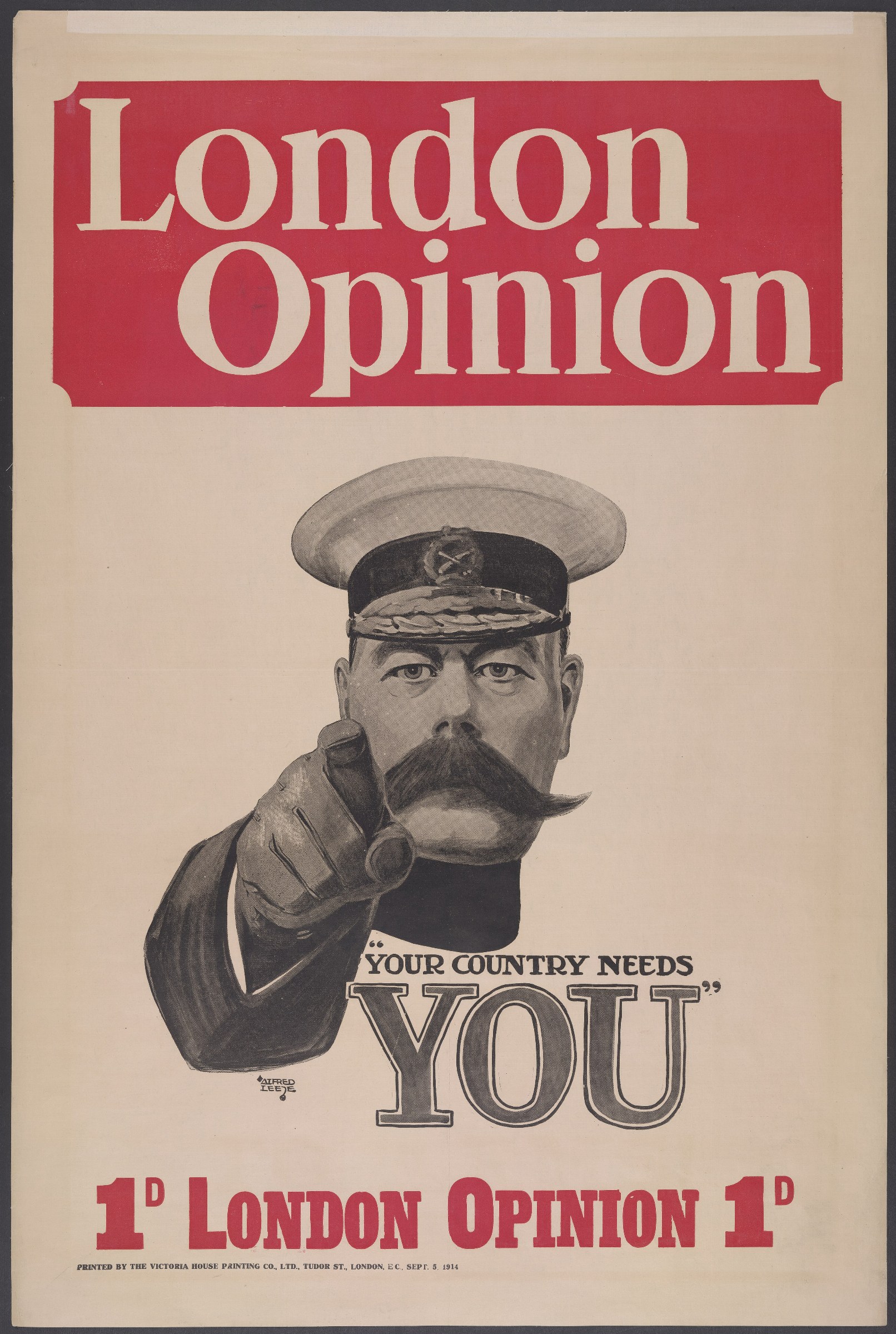
Appeal to authority Kitchener's face Not a symbol but the Secretary of State for War himself, the most famous soldier in the empire. The order comes from a man who could give it.
-
2
Camera angle The pointing finger The finger is drawn in foreshortening so that it points at the viewer from any angle, and the eyes are set to meet his. The composition singles out whoever is looking.
-
3
Loaded language "YOU" The pronoun in quotation marks, as if Kitchener had said it to the reader personally. The finger and the eyes are drawn to make the singular stick.
-
4
Slogan "Your country needs you" Four words that outlived the poster and were borrowed by every army that saw it. "Your country's" turns the army into something the reader already owns and has only to collect.
-
5
Transfer The London Opinion masthead This sheet sold a magazine. The urgency of the war's first month was borrowed to move copies at a penny, and the recruiting message traveled on the magazine's advertising.
From Kitchener to Uncle Sam 1914–1917 · Recruitment
Alfred Leete drew Kitchener's pointing head for the cover of the magazine London Opinion on 5 September 1914, under "Your country needs you," and the magazine printed this sheet to advertise the issue at a penny. The War Office never adopted it; the Parliamentary Recruiting Committee's own Kitchener posters used a different design, and the famous image was far rarer on the streets of 1914 than its fame suggests. Its influence came through the copies: Flagg's Uncle Sam in 1917, Moor's Red Army man in 1920, and a century of parodies.
- The face is the Secretary of State for War, not a symbol. What does using a real man do that Uncle Sam does not?
- The sheet is an advertisement for a magazine. Does that change what it is?
- Flagg and Moor both copied this pose. What in it travels across countries and causes?
See also
Same era, or the same techniques.