The pig trained in Paris
 1
2
3
4
5
Other · File:Polish Pig trained in Paris, Russian propaganda poster 1920.PNG · Public domain · Catalog record
The pins
Context
For discussion
-
1
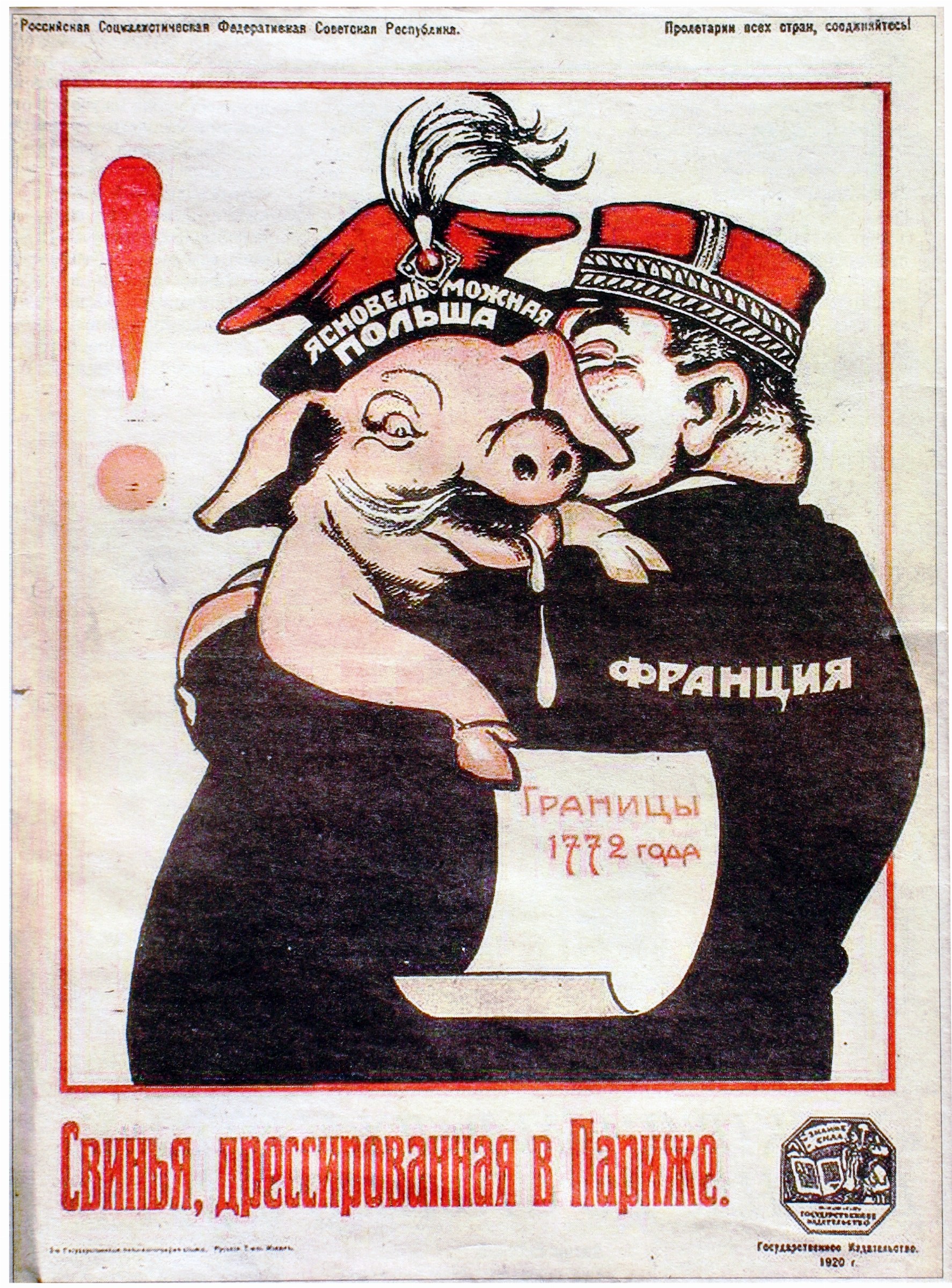
Dehumanizing imagery The pig Poland as a pig with a mustache, drooling. The animal chosen says greed, and a pig's demands do not need an answer.
-
2
Loaded language The cap "Most Illustrious Poland" on a pig's cap: the nobility's honorific used as a joke, the same device as on the bulldog poster.
-
3
Guilt by association France A French officer embraces the pig. The war is explained as French policy, which lets the poster call it foreign aggression rather than a dispute between neighbors.
-
4
Oversimplification "The borders of 1772" Poland's claims to the east reduced to a scroll demanding the frontiers before the partitions. A real and complicated dispute becomes a single absurd demand.
-
5
Name-calling The caption "The pig trained in Paris." The caption tells the viewer what the picture already told him, so that the phrase can be repeated without the picture.
Viktor Deni's "Svinya, dressirovannaya v Parizhe" from the Polish-Soviet war of 1920. A pig in a plumed cap labeled "Most Illustrious Poland" is embraced by a French officer whose coat says "France"; the pig clutches a scroll demanding "the borders of 1772," Poland before the partitions. Soviet posters of the war were careful to distinguish the Polish "pan," the landlord, from the Polish worker, whom they claimed as a brother; the pig did that work.
- The enemy is a Polish aristocrat, not Poland. Why the distinction?
- France has its arm around the pig. What is being claimed about who wanted the war?
- Compare the pig with the gorilla of "Destroy this mad brute." What is each animal chosen to say?
See also
Same era, or the same techniques.