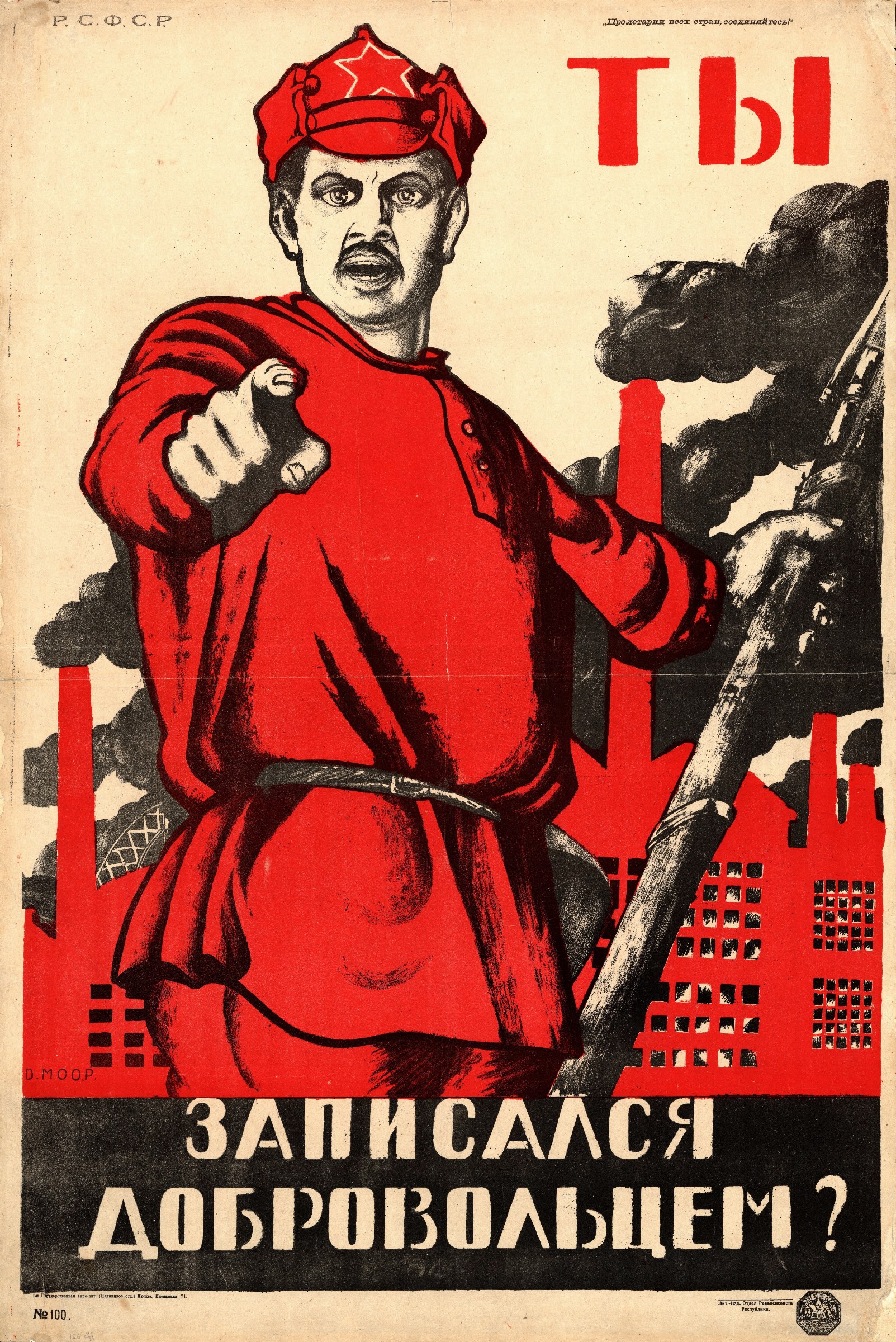
Have you volunteered?
The pins
Context
For discussion
-
1
Loaded language "ТЫ" (You) The familiar "ty," used between comrades and to children, not the polite "vy." The state addresses the viewer as an equal who has let the others down.
-
2
Plain folks The face A workman's face with a mustache, not a general's. The Red Army is drawn as the viewer himself, already in uniform.
-
3
Transfer The pointing finger The pose is Leete's Kitchener of 1914 and Flagg's Uncle Sam of 1917. Moor borrowed the device from the capitalist powers it was now turned against.
-
4
Color and typography The red shirt Red shirt, red cap, red factories, red star. The color is the argument: everything worth defending is one color, and so is the man asking you to defend it.
-
5
Loaded question The question "Have you volunteered?" assumes that volunteering is what a decent man has done. The only honest answer for the viewer who has not is the one the poster wants.
Dmitry Moor's "Ty zapisalsya dobrovoltsem?" of June 1920, printed in about fifty thousand copies during the war with Poland. A Red Army soldier in a pointed budenovka cap points at the viewer against a red ground, a factory with smoking chimneys behind him. The pose is Leete's Kitchener and Flagg's Uncle Sam, which Moor knew; the question is in the familiar "ty," as one comrade speaks to another. It remained the best-known Soviet poster of the civil war.
- Compare this with "I want YOU for U.S. Army." What has been kept, and what has changed?
- Why is the soldier a worker and not an officer?
- Why is the question asked in the familiar form of address?
See also
Same era, or the same techniques.