From Kitchener to Uncle Sam
Britain fought the first eighteen months of the First World War with volunteers, and the posters that raised them are the most reproduced propaganda ever made. The United States borrowed the best of them in 1917. This is what the posters did, and how.
The campaign
Britain entered the war in August 1914 with a small professional army and no conscription. Lord Kitchener, the new Secretary of State for War, asked for a hundred thousand volunteers in the first week and got them; by the end of September half a million men had enlisted, and the problem was not finding recruits but equipping them. The Parliamentary Recruiting Committee, formed that month from the three main parties, took over the campaign and ran it until conscription arrived in January 1916. It issued more than a hundred poster designs in print runs that totaled several million sheets, pasted on hoardings, buses, and railway stations across the country.
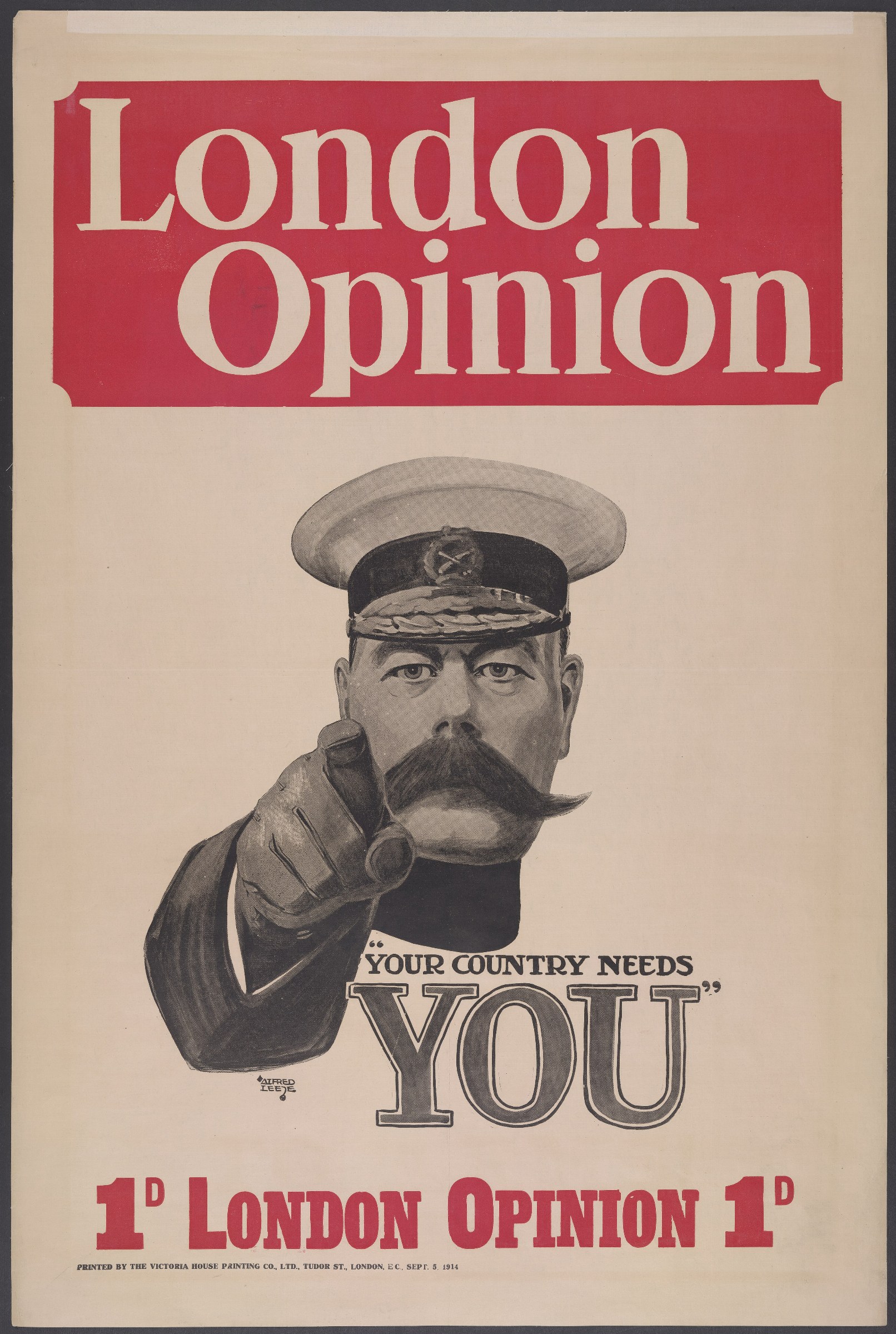
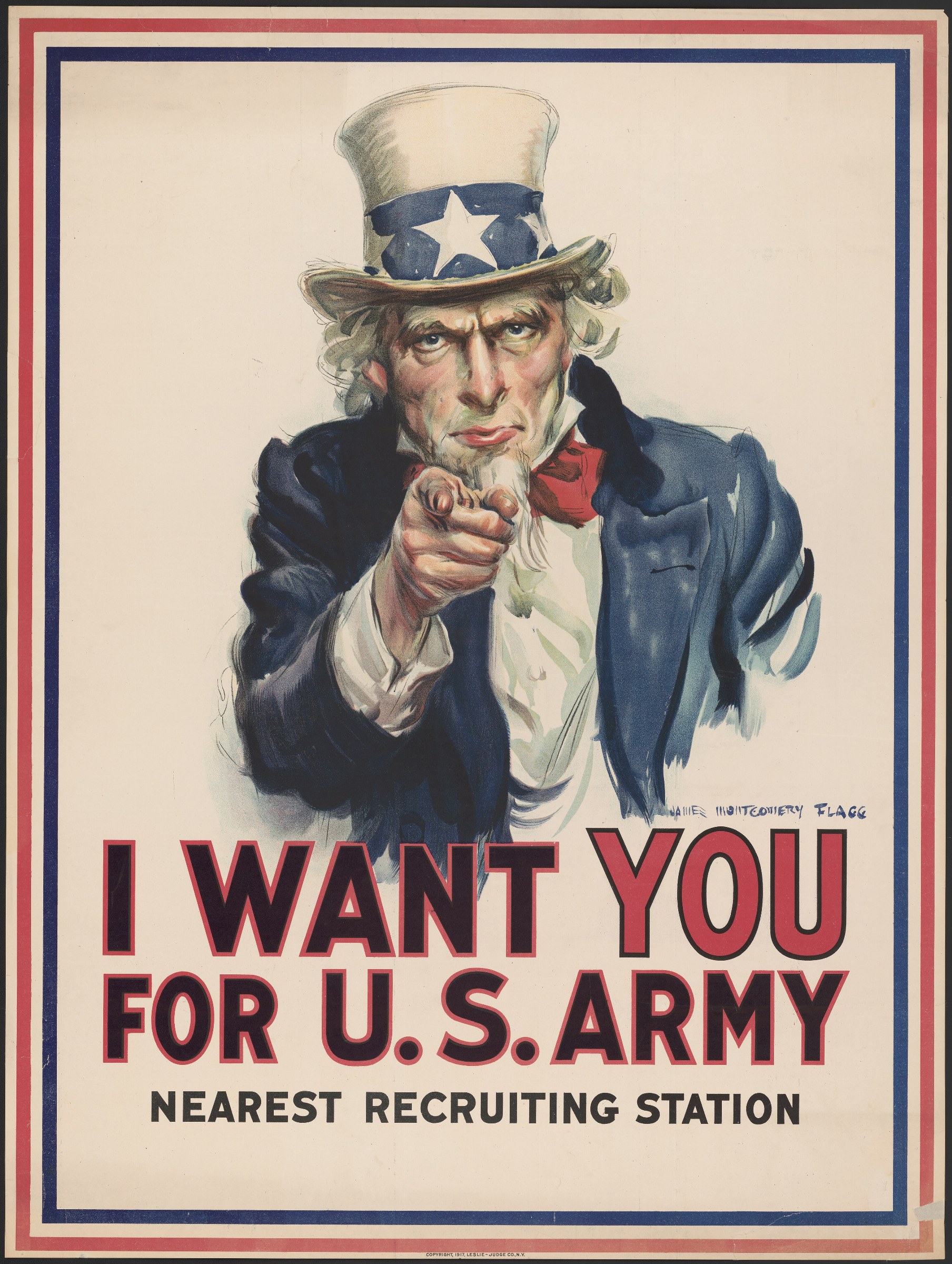
The most famous image came from outside the committee. Alfred Leete's drawing of Kitchener, pointing at the viewer above the words "Your Country Needs You", was the cover of the magazine London Opinion on 5 September 1914. The committee adapted it, and it went up in various forms through 1914 and 1915. How widely it was actually posted has been argued over by historians; what is not in doubt is that the pointing finger became the template. James Montgomery Flagg used it for Uncle Sam in 1917, for the American campaign, and his "I Want YOU for U.S. Army" was printed in more than four million copies. Versions appeared in Germany, Italy, Russia, and later the Soviet Union.
Who ran it and why
The committee was a political body and its posters reflected a political problem. Britain had never conscripted, and the Liberal government did not want to start. The posters had to produce an army without the state compelling anyone, which meant that the compulsion had to come from somewhere else: from the viewer's family, neighbors, employer, and sense of himself. The designs were produced by commercial artists and printers working to the committee's briefs, and they drew on the visual language of advertising, which had been addressing the viewer directly, in the second person, for a generation.
The American campaign of 1917 had a different problem, since conscription was enacted within weeks of the declaration of war, and the posters there served to make the draft popular rather than unnecessary. The Division of Pictorial Publicity, under Charles Dana Gibson, could call on the best illustrators in the country and did; Flagg produced forty-six designs for the war effort.
The techniques, in order of weight
Flag Waving is the frame of nearly every sheet. "Your Country Needs You" addresses the viewer as a national subject and makes enlistment the proof of that identity. The American versions substitute Uncle Sam for Kitchener but keep the proposition: the nation is a person, and it is asking you.
Bandwagon did much of the recruiting. Robert Baden-Powell's "Are YOU in this?" (1915) lines up a soldier, a sailor, a nurse, a munitions worker, a Boy Scout, and a farmer in a chain of national effort, with one idle figure in a suit standing apart; the question invites the viewer to notice which figure he is. Posters that printed the numbers already enlisted, and the "Pals' battalions" that recruited whole workplaces and streets together, worked the same lever.
Transfer gives the pointing poster its power. Kitchener was the most famous soldier in the Empire, and the design carries his authority straight into the viewer's eye line; the viewer is not reading an argument but being looked at by a hero. Uncle Sam does the same for a nation.
Appeal To Fear and the related Guilt By Association appear in the posters that addressed the family. Savile Lumley's "Daddy, what did YOU do in the Great War?" (1915) shows a father, years hence, unable to answer his children; the fear is of shame rather than death. E. J. Kealey's "Women of Britain say Go!" (1915) puts the pressure in the mouths of wives and mothers watching from a window.
Slogan and Repetition made the campaign cumulative. A handful of lines, "Your country needs you", "Enlist today", "Fall in", were repeated across dozens of designs until they functioned as a single voice.
Plain Folks appears in the American material in particular, where the recruiting office is "nearest" and the sergeant is a neighbor, and in British posters that showed ordinary clerks and laborers in uniform.
The artifacts
Two items in the archive anchor this study. The Library of Congress's copy of the Parliamentary Recruiting Committee's "Lord Kitchener says: Enlist to-day" (1915) shows the campaign's method once the first rush had passed: Kitchener's authority, a quotation that makes the viewer's duty explicit, and an instruction with a time attached. Flagg's "I Want YOU for U.S. Army" (1917), the most reproduced poster in American history, carries the same structure across the Atlantic with a national personification in place of a general.
Reading the two together shows how little the technique changed and how much the register did. The British sheet is wordy, formal, and institutional; the committee's name is on it and the appeal is to duty. The American sheet is a face and four words. Flagg, who used his own features for Uncle Sam to save the cost of a model, understood that the finger and the eyes did the work and that the text was a caption. Later recruiting posters on both sides of the Atlantic followed the American reduction rather than the British elaboration.
A reader who wants the full set should look at the Library of Congress's World War I poster collection, which holds nearly two thousand items from the belligerents, and at the Imperial War Museum's collection of the Parliamentary Recruiting Committee's output, which is the most complete record of the British campaign.
What happened
Nearly two and a half million men volunteered in Britain before conscription, the largest volunteer army in history. Whether the posters produced them is harder to say. The great rush of 1914 came before most of the posters existed, driven by news, employers, and the expectation of a short war; the posters' main period, 1915, was one of declining enlistment, which the committee's rising emotional pressure, from Kitchener's finger to the children's question, was designed to reverse. It did not reverse it enough, and the Military Service Act of January 1916 ended the experiment.
The afterlife was longer than the campaign. The pointing poster became a universal form, parodied and reused for a century, and the committee's methods of direct address, visible participation, and family pressure went into every subsequent recruiting campaign and most advertising. "Daddy, what did YOU do" became an embarrassment within a decade, as the war's survivors looked back on the emotional pressure that had sent them, and Lumley is said to have regretted it.
There is a further lesson in what the posters left out. None of them mentions the conditions of service, the casualty rates that were already known by 1915, or the political question of why Britain was at war at all, which was being argued in Parliament while the posters went up. The committee did not conceal these things; it simply had no use for them. A poster that gave reasons would have invited the viewer to weigh them, and the committee's whole purpose was to produce an enlistment without a weighing. The modern reader, who meets recruiting campaigns for everything from the armed forces to volunteer schemes, can apply the same test: what would this message have to say if it had to give a reason, and why does it not.
What it teaches
These posters are the archive's foundation because the techniques are so plain. There is no argument on any of them: no statement of war aims, no account of the enemy's conduct, no reason. There is a nation that needs you, a crowd you are not yet part of, a hero who is looking at you, and a child who will ask. The campaign recruited an army with those four things, and the methods have been in use ever since.
The artifacts
Every item this study shows, annotated.
- None of the posters gives a reason to enlist. What does each offer instead, and why might that have been more effective than an argument?
- Britain's posters had to produce volunteers; America's had to make a draft popular. Can you see the difference in the designs?
- "Daddy, what did YOU do in the Great War?" was later regretted by its own artist. What makes a technique feel acceptable in the moment and shameful afterwards?
- The pointing finger has been reused for a hundred years, often as a joke. Does a technique stop working once everyone recognizes it?
Sources
- Sanders, M. L., and Philip M. Taylor. British Propaganda during the First World War, 1914–18. London: Macmillan, 1982.
- Taylor, James. Your Country Needs You: The Secret History of the Propaganda Poster. Glasgow: Saraband, 2013. ISBN 978-1887354974
- Simkins, Peter. Kitchener's Army: The Raising of the New Armies, 1914–1916. Manchester: Manchester University Press, 1988.
- Darracott, Joseph, and Belinda Loftus. First World War Posters. London: Imperial War Museum, 1972.
- Rawls, Walton. Wake Up, America! World War I and the American Poster. New York: Abbeville Press, 1988. ISBN 978-0896598881
- Library of Congress, Prints and Photographs Division. World War I Posters collection. https://www.loc.gov/collections/world-war-i-posters/