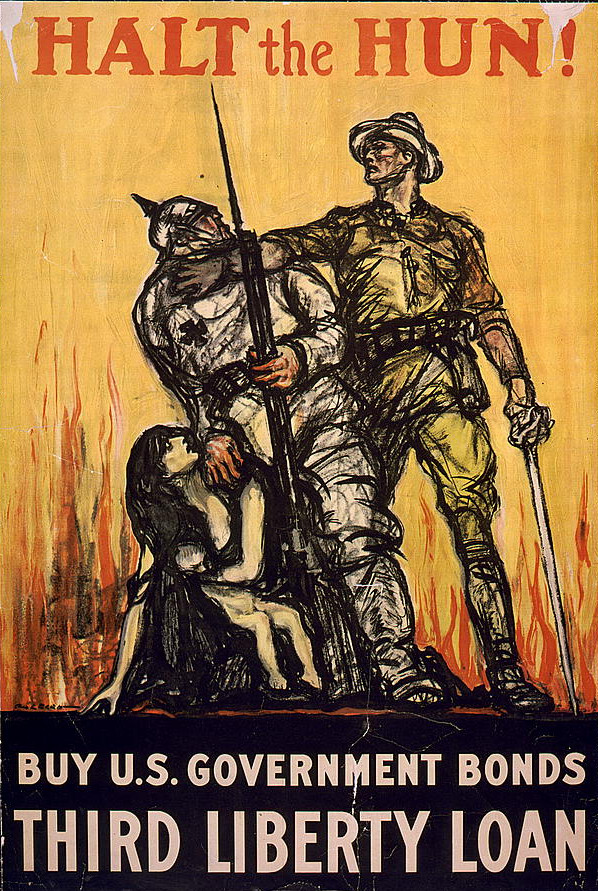
Halt the Hun! Buy U.S. Government bonds
 1
2
3
4
5
Library of Congress · LC-USZC4-2792 (color film copy transparency) · Public domain · Catalog record
The pins
Context
For discussion
-
1
Name-calling The headline "The Hun" recasts the German army as Attila's horde. The word came from the Kaiser's own speech of 1900 and was turned against him for the rest of the war.
-
2
Dehumanization The German soldier Drawn grey, faceless, and bloody-handed, the German is a shape rather than a man. He has no expression to read because he is not meant to be understood.
-
3
Us versus them The American soldier Clean, upright, lit in gold against the grey enemy. The two figures are drawn in different styles so that the viewer knows which side he is on before he has thought about it.
-
4
Appeal to outrage The woman and child The German's hand is on a kneeling woman's head, her child beside her. The scene is the atrocity story of 1914 drawn as if it were happening now.
-
5
Transfer The bond line Nothing in the picture concerns money. The anger it raises is transferred to a government bond, so that buying one feels like the soldier's grip on the German's arm.
Henry Raleigh's poster for the Third Liberty Loan of April 1918. An American soldier, lit from behind by a burning village, catches the arm of a German soldier who is reaching for a woman and child. "The Hun," borrowed from the Kaiser's own 1900 speech urging his troops to behave like Attila's, was by 1918 the standard American name for a German. The loan drive raised more than four billion dollars.
- The poster sells bonds, yet it shows no money, no bank, no bond. How does it connect the picture to the purchase?
- Why "the Hun" rather than "the German"?
- Who is the woman, and why is she drawn the way she is?
See also
Same era, or the same techniques.